


Dr Andrew Robert Watson: Introducing the Housing Stewardship Framework
 Reading time: 5 minutes

Dr Andrew Robert Watson proposes the development of a Housing Stewardship Framework for understanding and improving how housing quality is produced and sustained across the system.
Housing quality matters. There are well-established links between the condition of homes and levels of educational attainment, health outcomes, social mobility, and economic growth (Boyd et al., 2025; Hock et al., 2023; Thiele, 2002). Housing conditions also underpin a repair and maintenance sector worth between £2.5–3.0 billion per year, shape property values, and influence the safety and stability of neighbourhoods.
For these reasons, housing conditions are a central concern for governments, housing owners/providers and tenants alike. However, while there has been intergenerational improvement in housing quality across Scotland, and some recent gains in particular areas (see Figure 1), significant challenges and stark inequalities persist across all sectors. These outcomes are underpinned by complex and uneven approaches to how residential property is governed, managed, maintained, and upgraded over time.
Despite this, housing conditions risk being marginalised amid a wider polycrisis characterised by housing emergency declarations, acute supply shortages, affordability pressures, and major legislative reform. The recent announcement of More Homes Scotland, a new national housing agency, is likely to exacerbate the situation by absorbing significant policy and sectoral attention.
Figure 1: Percentage of Scottish dwellings with any disrepair to critical elements
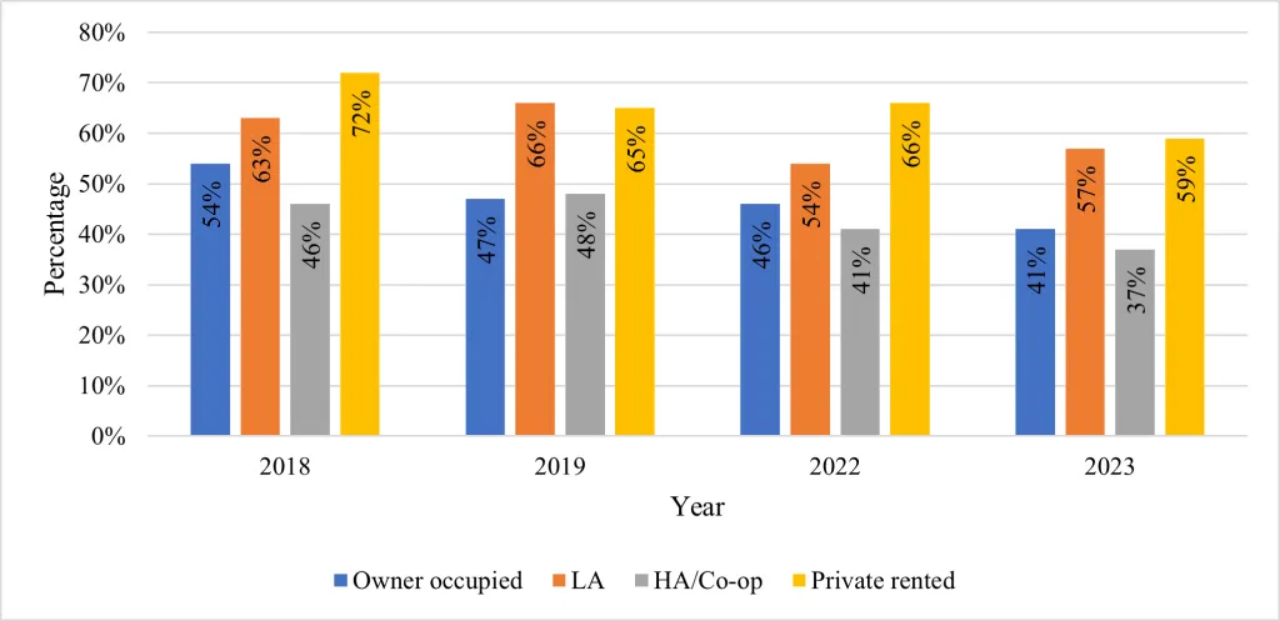
Source: Scottish House Condition Survey: 2023. Some data was not collected in 2020 and 2021 due to the Covid-19 pandemic.
The Scottish Government (2021) has stated its commitment to improving housing conditions, and strengthened the legislative and regulatory frameworks governing housing standards. However, the approach varies by tenure, leading to different governance and enforcement regimes and uneven outcomes. There are also longstanding questions over the effectiveness of the successive layers of regulation that have been brought forward and concerns regarding levels of compliance, particularly within the Private Rented Sector (Earley et al., 2025; Marsh & Gibb, 2019; Watson, 2025).
More direct Scottish Government intervention aimed specifically at improving housing conditions across tenures is relatively rare and typically focuses on discrete risks or safety issues, such as those addressed by the Cladding Remediation Directorate. Local authorities play a broader role in intervention across tenures, although their ability to fund housing improvements has been constrained by national policy and funding reforms, as exemplified by the reduction in large-scale private sector repair grants over time (Preece et al., 2021).
In many respects, current policy framing treats housing conditions as an outcome to be monitored through inspection and corrected through regulation. This shallow, output-focused approach fails to consider key inputs relating to governance arrangements, funding mechanisms, asset management strategies, professional cultures, and behavioural factors. This prevents a more holistically focused appraisal that could potentially lead to system-wide improvement.
To respond to these challenges, this short blog argues for a collective, renewed analytical re-focus on housing conditions. Specifically, it proposes a system-wide examination of how (and to what extent) different housing owners/providers keep homes safe, functional, and in good condition over time. By comparing these insights, it would be possible to identify and share best (and worst) practice with the aim of encouraging improvements in housing conditions.
This is no easy task given the level of provider heterogeneity. While the bulk of Scottish households reside in owner-occupation, or rent via social (e.g., housing associations and local authority housing) or private providers (e.g., the private rented sector) there are stark differences between these categories. There are also those living in tied housing, build-to-rent housing (BTR), purpose-built student accommodation (PBSA), halls of residence, single-family housing (SFH), military housing, clergy housing, temporary accommodation, bedsits, among others, to consider.
Most of these forms of provision exist in silos with distinct characteristics, markets, funding models, regulatory frameworks, governance structures, management systems, and professional cultures. There is limited evidence, within and across these silos, on how these differences impact upon the reactive, planned, and preventative maintenance regimes and capital works that underpin housing conditions. Even less is known about how individual providers prioritise spend, structure accountability, and in some cases, measure performance. This constrains efforts to identify best practice, share learning, and improve housing quality across all housing tenures.
One way to respond to these challenges is through the development of a Housing Stewardship Framework (HSF), which could be used for theorising, understanding, comparing and benchmarking how differing approaches to housing asset management shape and sustain housing quality, while also identifying best practice and structural weaknesses. The term stewardship is used deliberately to acknowledge that the lifespan of housing frequently outpaces that of its owners or managers, requiring practices that safeguard properties in the long-term.
The framework would draw from a range of disciplines, theories, frameworks, standards and contemporary debates within housing studies and beyond. It would be designed iteratively in partnership with housing providing/owners. While this would require a commitment of time and resource, the framework represents a proportionate and necessary methodology for understanding and improving how housing quality is produced and sustained across the system.
However, articulating the case is one thing. Securing the funding to do this work properly is another. If you are interested in discussing the ideas set out here or exploring how a Housing Stewardship Framework might be developed or applied, please do get in touch.
- This article was originally published on the UK Collaborative Centre for Housing Evidence website.

Share this article:

Subscribe to our newsletter to not miss articles like this one:
 SUBSCRIBE