

Dr Jocelyne Fleming: No more tinkering around the edges - it’s time to be brave
 Reading time: 5 minutes

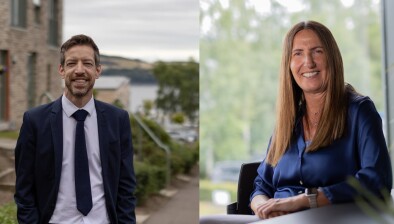
Hard Hat Talks Podcast host Kenneth Martin with Dr Jocelyne Fleming and David Raine
Dr Jocelyne Fleming, the Chartered Institute of Building’s Scottish policy and public affairs lead, calls for joined-up policy interventions to truly transform the construction sector.
The recent Scottish Construction summit was full of fantastic conversations, both on and off the stage, many of which have stayed with me.
For instance, I spoke with a colleague who shared his thoughts on previous times of significant change in Scotland’s skills and apprenticeships landscape. I asked whether he felt like we might once again be on the precipice of big shifts for the sector. His answer, broadly, was yes.
And I think we need to be.
As the day went on, I realised I was hearing versions of the same conversation everywhere; there seemed to be a real appetite for radical change.
Not change for its own sake, and certainly not an assumption that every part of the existing system needs to be torn up. But an acknowledgement that tinkering around the edges of systems struggling to deliver the outcomes Scotland needs is unlikely to be enough.
And the timing is rather impeccable.
There are several opportunities in the current policy landscape to deliver this kind of system-wide change. From skills and education to housing delivery, planning, public service reform and a devolution agenda that reconsiders the distribution of powers and responsibilities across levels of government, there are an unusual number of policy reform pieces in play.
Taken individually, each presents an opportunity for improvement. Taken together, they offer something potentially much more significant: a bona fide chance to change how the construction system works.
Take skills.
Scotland is already changing the way apprenticeships and work-based learning are governed and funded. The Scottish Funding Council will take on new responsibilities, supported by a new Apprenticeship Committee. At the same time, wider reforms to qualifications, curriculum, and education are underway.
Industry research has opened up a wider conversation about whether the routes we currently use to attract, train and develop our workforce can produce the people and skills we will need.
We unquestionably need investment in skills. But there is an opportunity to ask a bigger question than simply how we put more resource into the existing system: if we were designing pathways into construction around the workforce Scotland actually needs to deliver its housing, infrastructure, and climate ambitions, would we design them as they operate today?
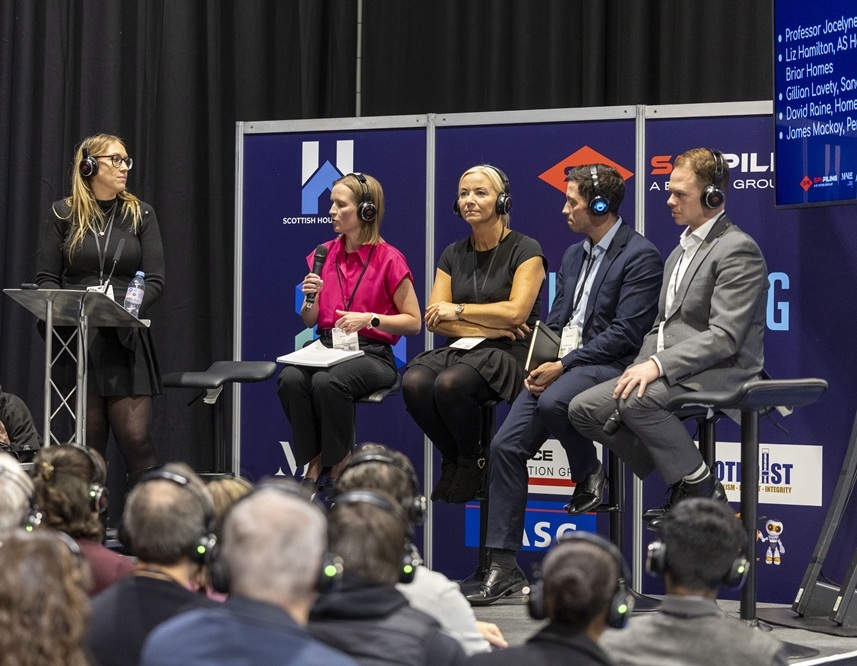
A panel discussion around what the housing sector needs from More Homes Scotland was chaired by Dr Jocelyne Fleming, Scotland lead and policy manager at CIOB, and included (frmo left) Liz Hamilton, senior land and planning manager at AS Homes (Scotland) and Briar Homes; Gillian Lavety, development director for Scotland at Sanctuary Scotland; James Mackay, regional managing director at Persimmon Homes; and David Raine, head of policy development at Homes for Scotland
Housing is facing a similar moment.
I chaired a panel at the Summit on More Homes Scotland, and one phrase I heard repeatedly about the new agency is that it needs to have teeth.
If More Homes Scotland is to make a meaningful difference, it cannot simply add another administrative layer to an already complicated delivery landscape. It needs to help bring together the different parts of the system required to take housing from ambition to completion.
That means more than housebuilders. It means local government, planning, infrastructure, utilities, housing providers, finance, skills, and the many actors whose decisions ultimately determine whether a consented home becomes an actual home.
Government has also been exploring fiscal measures to accelerate development, changes to planning and ways of unlocking stalled sites. Meanwhile, the wider structures surrounding delivery could themselves change significantly.
The Scottish Government has committed to widespread public service reform and opened a potentially far-reaching conversation about local governance. I wrote recently about what greater devolution might mean for the built environment and where decisions about our homes, infrastructure and places are best made.
Any one of these reforms would have implications for construction. Taken together, they represent something much more interesting.
We have an opportunity to think differently about the system itself.
There is, of course, a risk here too. Reforming skills over here, housing delivery over there, planning somewhere else and public services somewhere else again will not automatically produce a better system.
That is why the starting point needs to be what we are trying to deliver.
If Scotland wants more and better homes, improved infrastructure, safer and higher-quality buildings, a successful transition to net zero and a productive economy, what needs to happen to deliver those outcomes? Who needs to be involved? Where should decisions sit? What skills and capacity do we need? What gets in the way now?
Then we can work backwards.
One of the other things I heard repeatedly at the conference was that the construction sector is resilient. Adaptable. Dynamic. But there is a difference between asking an industry to adapt within a clear direction of travel and asking it to navigate continual uncertainty, fragmented interventions, and systems that do not always work together.
The sector needs long-term certainty and clarity if it is going to invest, recruit, train and innovate at the scale Scotland needs.
There are an unusual number of moving pieces on the board at the moment. That brings uncertainty, but it also brings opportunity. Business as usual will not deliver everything we are asking of Scotland’s construction sector. Nor will a succession of small fixes around the edges.
Now is the time to think bigger, to join up policy changes that might otherwise be taken independently, and to be willing to meaningfully change things that are no longer working.
Scotland, it’s time to be brave. If not now, when?
Photography courtesy of Jeff Holmes.

Share this article:

Subscribe to our newsletter to not miss articles like this one:
 SUBSCRIBE