

Government prioritises early action with updated child poverty plan
 Reading time: 6 minutes
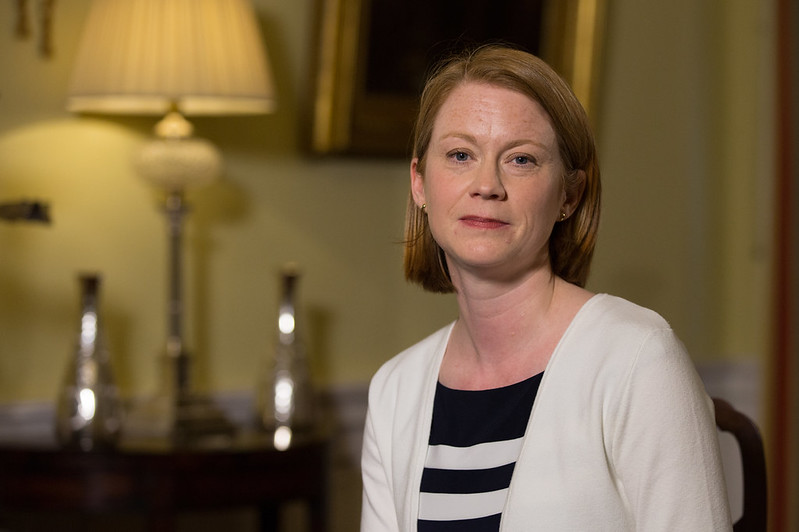
Social justice secretary Shirley-Anne Somerville
The Scottish Government is to commit more than £111 million to updated plans to eradicate child poverty.
Bringing Hope, Building Futures aims to help keep approximately 100,000 children out of poverty in 2026-27.
It builds on existing Scottish Government action which has already reduced relative child poverty rates in Scotland to the lowest levels in almost a decade – with rates nine percentage points lower than the UK in 2023-24.
Action includes:
- Investing £61.5m in the Tackling Child Poverty Fund to strengthen and introduce measures, including to expand childcare support for low-income parents, help employers offer progression opportunities, grow the Family Nurse Partnership to help up to 500 more young parents during pregnancy and into parenthood, and to expand Bookbug
- A £20m Whole Family Support Third Sector Delivery Fund for charities to help families in their communities
- £30m to boost incomes through work, create more training opportunities for parents by investing in the college sector, and to reduce transport costs for low-income parents travelling to work
- £9m to mitigate the UK Government’s freeze on Local Housing Allowance rates, which caps the amount of housing support a household can receive, to support up to 18,000 families.
Social justice secretary Shirley-Anne Somerville said: “Eradicating child poverty is the Scottish Government’s driving mission – no child should live in poverty in a country as rich as Scotland.
“This plan builds on a great deal of progress and sets out a broad range of actions to help parents – by reducing the cost of living, helping increase incomes received through work and social security, and helping their children to thrive.
“I am proud that Scotland is the only part of the UK to have statutory targets to drive down child poverty, which were unanimously agreed by parliament. Our plan focusses on concrete action this year while providing the foundations on which any incoming administration can build and reflect its own policy priorities, working with industry, local authorities and charities, to give children in Scotland a future free from the scourge of poverty.”
CIH Scotland said it welcomed the Scottish Government’s recognition of housing as a key factor in tackling child poverty.
Responding to the publication of the strategy, Ashley Campbell, policy manager at CIH Scotland – who gave evidence at Parliament in January this year in support of additional discretionary housing payments – said: “We welcome the recognition of the role of housing in tackling child poverty set out in the Scottish government’s latest delivery plan. Housing costs are one of the biggest factors in poverty, and providing good quality affordable housing ensures that children have the best start in life and a chance to thrive.
“CIH has long called for more to be done to meet the shortfall in local housing allowance caused by repeated UK government benefit freezes which is making the private rented sector unaffordable and pushing thousands of households into poverty and homelessness. Providing an additional £9 million in discretionary housing payments for LHA shortfalls will certainly go some way to help, but in the long term we urge the UK government to commit to providing social security at a level that covers the real cost of renting, providing certainty and security for low-income households.
“We also welcome the Scottish government’s continued commitment to rapid rehousing transition plans (RRTPs) and the further £8 million for 2026/27 which was first announced in the Housing Emergency Action Plan. If we are to tackle homelessness in Scotland, we need continued commitment to transform the homelessness system and we need to see RRTP funding guaranteed beyond just the next financial year.”
Maeve McGoldrick, head of policy and communications at Crisis Scotland, said: “Homelessness remains one of the most extreme forms of poverty, and so we strongly welcome today’s announcement on funding holistic, early action support for family households.
“We especially welcome the investment from Scottish Government to plug the gap left by the Department for Work and Pensions in housing benefit levels for families renting privately.
“Rising living costs, a shortage of genuinely affordable homes and gaps in early intervention support are continually pushing more people into inhumane living situations.
“Today’s announcement will offer some hope to those living in fear of losing their homes, and to those who are already experiencing homelessness.
“However, to bring about an end to homelessness, government must continue efforts to expand this support to everyone at risk of or experiencing homelessness.”
Maeve McGoldrick added: “We cannot end poverty without ending homelessness. That is why every political party contesting the next Holyrood election must commit to ending homelessness for good by 2040.”
Shelter Scotland director Alison Watson said: “We know home is the foundation of everything and you can’t tackle child poverty without tackling child homelessness. With 10,480 children trapped in temporary accommodation, this additional Discretionary Housing Payments funding should be targeted at councils where it is most needed with the highest levels of children waking up without a home.
“The fact that £9m is being used to mitigate the impact of the UK Government’s freeze on Local Housing Allowance shows the scale of the situation and the impact it is having on families across the country. This is why Shelter Scotland, along with over 40 organisations called upon Westminster to end the freeze and restore LHA rates to at least the 30th percentile of rent. Until this happens, too many children will continue to grow up without the security of a safe and affordable home.”
Dave Hawkey, senior research fellow at IPPR Scotland, added: “Today’s reiteration of the Scottish Government’s commitment to tackle child poverty is welcome. But the government’s own modelling anticipates current policies are on track to miss the 2030 target.
“Child poverty is an issue of inequality. Policies that focus only on one side of that equation can only do so much. Eliminating child poverty requires a greater degree of sharing across society, closing the gaps by working across the whole of the income spectrum. In practice, this means higher taxes and better funding of public services as the route to building collective prosperity.
“As global conflict brings another round of inflation into view, the imperative to support low-income families becomes ever more acute. Commitments in the action plan need to be accompanied by clarity in what the Scottish government will to do keep kids afloat in the short term if the cost-of-living crisis deepens this year.”

Share this article:

Subscribe to our newsletter to not miss articles like this one:
 SUBSCRIBE