





Written by:

Housing Champion: Lesley Baird on 26 years of putting tenants in the driving seat
 Reading time: 11 minutes
Written by:

Lesley Baird
Former TPAS Scotland chief executive Lesley Baird talks to Scottish Housing News editor Kieran Findlay about scaffolding, chairing a Congress of 27 nations, and why tenants have always known best.
Lesley Baird may downplay her role in making sure tenants have a real say in the running of their own homes, but ask almost anyone who has worked with her over the past three decades, and they’ll tell you Lesley helped shape tenant participation in Scotland and even beyond.
“I kind of fell into housing,” she recalled. “I didn’t actually know it was a career choice at all, but once I got there, it definitely became my career of choice.”
Her first brush with housing came as a community development worker in the Three Towns of Ayrshire. A council redevelopment programme had stalled, with scaffolding up for years, and the local tenants group had split into two warring factions.
Lesley’s approach was to ask what they actually wanted. “When it came down to the bit, everyone wanted the same thing. They wanted their new roofs, they wanted their new windows, and they wanted the scaffolding taken down.” Nobody had to become best friends. They just needed a shared focus.
That lesson followed her to Kyle and Carrick District Council, later South Ayrshire Council, where she became tenant participation officer. It was there, at a public meeting in Ayr Town Hall, that she learned the gentle art of suggesting the obvious.
Tenants were being asked to vote on window styles. The room split 50-50. Restricting the vote to one person per household made no difference. “I was fairly new in the job, and suggested that wouldn’t it be easier if people actually got what they wanted?”
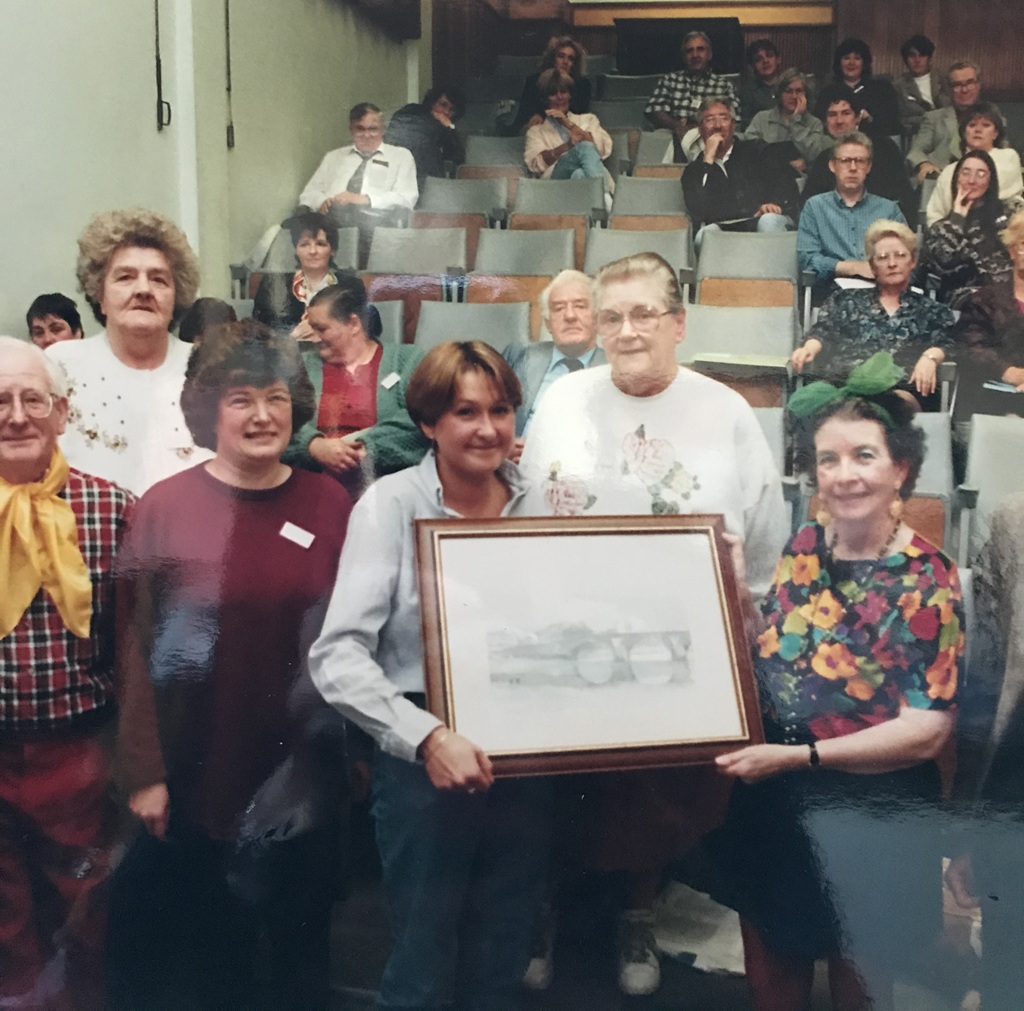
Lesley's last day of working in South Ayrshire (1996)
The next day brought a furious phone call. “I got a roasting for having the audacity to suggest that people could get their choice.” But the policy changed, and the politicians loved it.
Soon a group of tenants was reviewing policies, procedures and strategies in what would now be called a scrutiny group. They met in the kitchen of the council headquarters at night, so they became known as the kitchen cabinet. Lesley’s job was to report their views to the Housing Committee.
“The tenants in South Ayrshire had a lot of power,” she says, “and that was a great basis to work from.” It’s a formative story, and an early vindication of a belief that tenants should have a say in the running of their own home from the very start of any decision, not brought in once the plan is already made.
Joining TPAS Scotland and writing the law
Lesley was working with the team at TPAS Scotland running workshops to assess the council’s approach to tenant engagement when a development officer vacancy came up. She had previously applied for the chief executive position and was ‘shocked to get an interview’ but ‘not shocked when she didn’t get it’. She did, however, get the development officer vacancy and spent a rewarding 25 years, quickly working her way up to chief executive, retiring in 2022.
One thing she pushed from early on was training for housing staff as well as tenants. “Tenants were well trained, they knew what their roles were, what their responsibilities were, but staff didn’t. And that often came to conflict.” She developed programmes for both, sometimes jointly, and says staff inductions are now commonplace across the sector.
Scotland is highly regarded internationally as a country where tenants have an individual and collective legal right to participate, and Lesley was at the table when that was shaped alongside the then Scottish Tenants Organisation, politicians and senior civil servants.
She is candid about the atmosphere. Some landlords, she says, couldn’t see why tenants needed power when elected members already had it through the ballot box. “I fought vehemently for people to understand, this is not them and us. This is a partnership.” For Lesley, that fight was about principle as much as process. Tenants had to be written into decisions from the outset, with rights that held regardless of whether a landlord felt like listening that day.
She was equally firm about the individual right. “Groups are not for everyone.” For remote rural communities, where travel is a major barrier, and for people with support needs or whose first language isn’t English, there had to be a route for anyone with something to say.
The result was a robust statutory framework that mandates both individual tenants and collective groups (known as Registered Tenant Organisations, or RTOs) have a legal right to be informed, consulted, and involved in housing decisions. A legal right that also underpins the Scottish Social Housing Charter, which she helped develop.
Taking the Charter to the islands
That commitment to reach runs through her whole career. When the Scottish Government toured the country to consult on the Charter, Lesley persuaded them to go to Orkney, Shetland, Skye and Stornoway. Travelling to Edinburgh from Shetland can mean two or three days away from the islands at considerable cost, so most social landlords could afford to send one tenant and one officer at most.
“We regularly got 50 people turning up by one person, me, going to Shetland, or going to Kirkwall. That’s value for money.” She adds that islanders noticed. “They loved the fact that people from the Central Belt took the time to go up to visit them.”
Her rural work includes some hard-won lessons. Trying to encourage tenants to get involved in Elgin, she found herself standing at the entrance to a Tesco on a winter morning as snow blew through. And during a project with Lochaber Housing Association, she suggested holding a meeting in a village hall at 7pm. A tenant on the forum pointed out that deer don’t wear headlamps. “My rural head didn’t even think about that,” she laughs.
The same project produced rent information that was less wordy, more cheerful and more pictorial, while staying factual, all shaped by tenants rather than handed down to them.
Then there’s Scalpay. Lesley was visiting a sheltered housing complex in the Outer Hebrides when the oldest resident, aged 109, refused to speak to her in English. She has since downloaded a Gaelic app, and practises with cousins who speak the language.
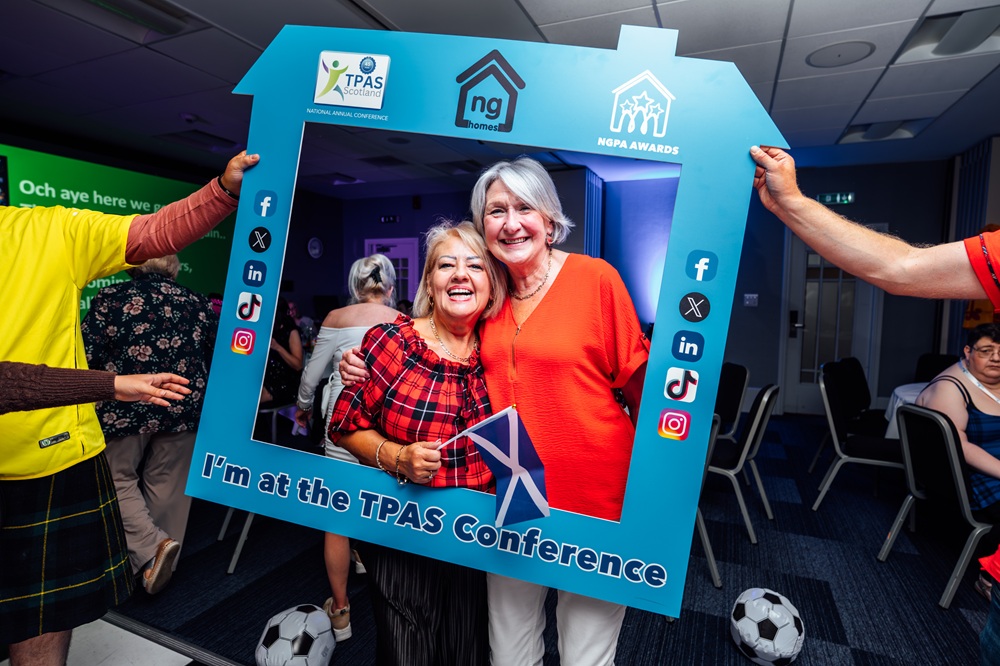
Lesley at the TPAS Conference 2026
Stock transfers and windows before heating
Lesley’s stock transfer and merger work is built on the same principle that tenants, not landlords, should set the agenda for their own homes. She describes a proposed transfer in Possilpark, Glasgow, where a prospective landlord set out a programme offering heating first and windows second. The tenants pointed out that their metal-framed windows would let the heat straight out, and wanted the order reversed. The landlord refused, insisting the programme was fixed and that they were the professionals.
It was the tenants themselves, not the landlord, who moved next. They organised a campaign to vote no on the whole deal unless the order was changed. “The tenants said, well, actually, we live in the homes, we have lived experience.”
Lesley’s role was to help build the bridge between the two sides once that campaign was under way, bringing the landlord to the table to hear the tenants’ case. Faced with the prospect of losing the vote, the landlord backed down. “They went back to the tenants and said, you’re absolutely right, we’ve got it the wrong way around.”
She is generous about that landlord, too. “Well done to them. I think they should be applauded.” But she is also clear about what provokes this kind of standoff in the first place. “Professional arrogance. I know better because I’ve done the course. Have you ever lived in a social rented house?”
Many of the big local authority stock transfers, she notes, didn’t go ahead because tenants voted no. She’s proud to have supported tenants in both directions. “Either voted yes because they loved what the package was, or no, because it just wasn’t something that was going to suit them.” In every case, tenants made the decision, and were not simply being consulted after the fact.
At Wheatley Group, Lesley facilitated a tenant scrutiny group whose members chose to investigate repairs after looking at the performance figures. When they asked what the biggest complaints were, the answer wasn’t quality or timescales. It was communication.
At the same time, Wheatley was developing its Book It, Track It, Rate It app, but the scrutiny group didn’t limit itself to that. They visited the call centre, interviewed staff including a plumber and the director of repairs, and had what Lesley calls an open door to everyone.
The result was a report with 18 recommendations. Seventeen were approved, and the 18th was already in place. Small details mattered, like the tenant who had told the landlord she wasn’t home during the school run, only to find a “while you were out” card through her door. “I’ve told you! It’s on the app.”
Lesley sees the partnership as the point. “The tenant experience and the professional experience brought together something that’s an excellent product.” She’s clear about her own role, too. “It was my job to facilitate that, to chair that, and to bring it together.”
Chairing 27 nations
One of Lesley’s proudest moments came when members of the International Union of Tenants asked her to chair its Congress in Krakow in 2013. It meets only every three years, and this one gathered delegates from 27 nations to talk about tenant participation.
Lesley says she has “never been so nervous but so excited and proud.” She had already made a study visit to the Swedish Tenants Union, where the IUT is based, and TPAS Scotland had joined the organisation. “They just seemed to like my approach to things, and they liked what we were doing in Scotland.”
After Krakow, delegates struggled to see how the Scottish Social Housing Charter and a legal right to participate could work in practice, so the Congress came to Glasgow in 2016, hosted by TPAS at the Wheatley Academy. Lesley stood on stage with the housing minister and attempted some Gaelic to welcome delegates. It was the first IUT Congress to have senior politicians on stage and Scottish Government sponsorship.
Delegates visited the Commonwealth Games Village, then being converted into social housing, and wanted to see “the good and the warts”. Presentations from countries such as Romania, where some allocated homes were simply not livable, reminded Scottish delegates how much power they had.
The hardest question she faced was why Scots want a front and back door rather than an apartment. “I still can’t explain it.” But what convinced delegates, she says, was evidence. “They had stories and situations where tenants had made a difference and changed people’s lives.”
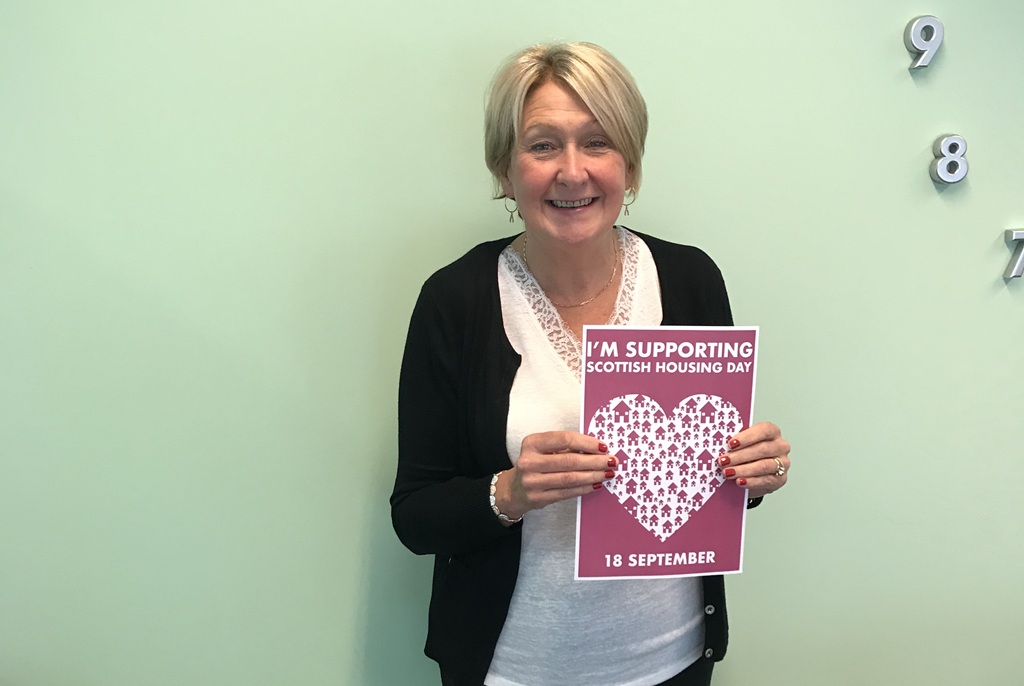
Lesley supporting Scottish Housing Day in 2019
Scottish Housing Day and a TPAS Scotland return
Her most visible legacy may be Scottish Housing Day. Lesley sat on a Scottish Government working group on communication and information, and had seen TPAS England supporting a national housing day. She freely admits she “pinched” it. But Scotland needed its own, because “we’re in a different nation, and our laws were a lot stronger.”
Documentaries such as ‘Nightmare Tenants, Slum Landlords’ on Channel 5 had given social housing a bad name, she says, and it was time to show it as a positive choice, not a last resort. Among the stories used were The Proclaimers, who were homeless until Link Housing Association rehoused them, and Nicola Sturgeon, brought up in a council house in Irvine.
Housing as a career, meanwhile, is a subject close to Lesley’s heart, and she has long wished landlords would take a stand at school careers fairs.
Lesley retired from TPAS Scotland, spent time as an associate, then stepped back again before the new chief executive Evelyn Armour asked her to return. “I can’t even pretend I said no.”
She is clear that the challenge now isn’t awareness but appeal. Tenant groups may not be as popular, and the days of 700-plus organisations may be gone, but she doesn’t think that’s a failure. “Kitchens get old. We need a new kitchen.” What’s needed is more informal, more creative engagement and attraction of younger people through things like TikTok videos, coffee with ten people who all complain about the same thing, repair operatives who take a tenant’s message back to the office. “Who do tenants see more often? Somebody coming into their house to do a repair.”
And she remains determined that information should never be dull, and that tenants should always be invited in rather than spoken for. “If it looks boring, it probably is boring. If you pass ten leaflets in a row, there’s going to be one you pick up. I want to be the person who developed that one.”

Share this article:

Subscribe to our newsletter to not miss articles like this one:
 SUBSCRIBE

