


Sharon Hannah: Get support for Telecare Migration
 Reading time: 4 minutes

Sharon Hannah
The January 2027 analogue switch-off is fast approaching. With around 125 working days remaining, Sharon Hannah, project manager at the Digital Office for Scottish Local Government, believes housing providers that still rely on analogue telecare must act now to protect residents, reduce service disruption and put a clear migration plan in place.
Register with Digital Telecare to access free support, guidance and Playbook resources.
Digital Telecare uses quarterly Alarm Receiving Centre (ARC) monitoring reports to identify organisations with linked telecare and support services. This helps build a clearer national picture of who may need support to transition safely.
So far, this work has identified 185 housing providers, including councils, housing associations and property management companies. Nearly 60% are already engaged with the programme, but we still need confirmation from others, particularly where telecare is not provided or where services are still dependent on analogue systems.
Engaging with Digital Telecare gives housing providers access to the Playbook, practical guidance, case studies and free support from project managers, senior advisers and technical consultants. Whether you need help assessing readiness, understanding options or progressing supplier conversations, we can help you take the next practical step.
What Housing Providers Need to Do Now
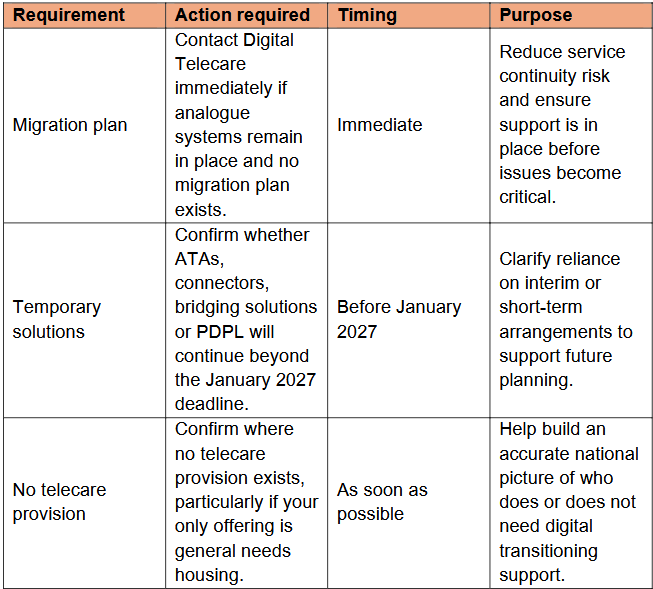
The digital switch affects grouped housing and individual homes where telecare is in place. If systems are not upgraded or replaced, residents may be left relying on services that are no longer fit for purpose.
This is not only a technology change. It is an opportunity to review whether existing warden call arrangements still meet residents’ needs, whether telecare is being used as intended, and whether a different model could provide better long-term support.
Start with Resident Needs
Many grouped housing developments still have warden call systems installed across every property, even where residents may not need or want telecare support. With changing assessment criteria and many residents aged 55+ living independently, a like-for-like replacement may not always be the right answer.
ARC call reports, housing staff insight and resident engagement can quickly show how telecare is being used, who relies on it and whether it is mainly supporting emergencies, day-to-day communication or wider housing management activity.
Evidence from migration work shows that emergency calls often represent a small proportion of overall call traffic, while door-entry and communication calls can be much higher. Understanding that usage can help providers make better decisions before investing in new infrastructure.
Castlehill Housing’s experience demonstrates the value of reviewing need before replacing systems. After assessing residents as part of a move to independent living, Castlehill found only 30% needed or wanted telecare. The organisation decommissioned 24 sites and supported those residents to move onto dispersed alarm services through their local council.
Register with Digital Telecare to access the Castlehill Housing case study and lessons learned.
Look Beyond Like-For-Like Replacement
The January 2027 deadline will not move. If a full tenure review is part of your strategy, there may not be enough time to complete everything before the switch-off. However, there is still time to assess current usage, identify who needs support and make informed decisions about the safest route forward.
East Lothian Housing used call data and staff knowledge to understand resident need, finding that only 25% of residents wanted telecare. The team focused on those residents, supported applications to the local council and explored dispersed alarm provision rather than replacing the full warden call system.
This approach allows housing providers to focus on housing, while Health and Social Care Partnerships or local council telecare services provide assessed
telecare support where it is needed.
Digital Dispersed Alarms Can Offer a Practical Alternative
For many residents, dispersed alarms can provide the same core telecare function: pressing a button or pulling a cord connects them to the ARC. This can be less disruptive, avoid additional infrastructure and replace older analogue equipment with new digital dispersed alarm units.
East Dunbartonshire Council has already moved residents in grouped housing from warden call to dispersed alarms, demonstrating how rapid digital transition can be delivered when providers engage early and focus on resident need. Their case study and recent presentation are available through the Digital Telecare Playbook.
Act Now – Support is Available
Migration planning protects residents, reduces operational risk and helps housing providers stay in control of the transition. If you are facing digital barriers, procurement issues, supplier decisions, ARC platform configuration or equipment questions, the Digital Telecare team can help. Contact
digitaltelecare@digitaloffice.scot or Sharon Hannah at Sharon.hannah@digitaloffice.scot.

Share this article:

Subscribe to our newsletter to not miss articles like this one:
 SUBSCRIBE