

Angela Currie: Warm words and new agencies will not house the 150,000 people still waiting for a home
 Reading time: 5 minutes
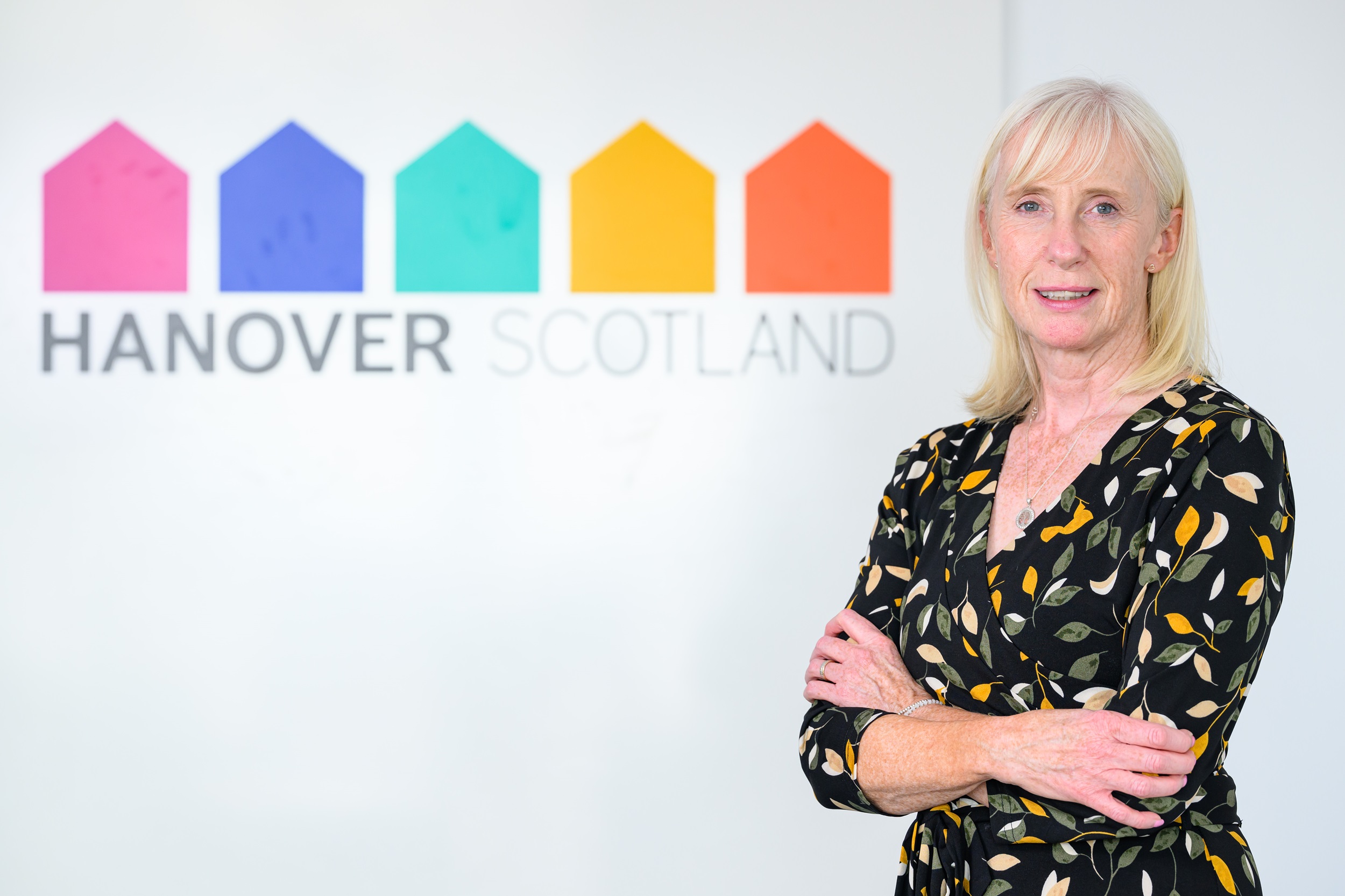
Angela Currie
Responding to the Scottish Government’s new More Homes Scotland agency, Hanover Scotland’s CEO Angela Currie stresses that the 150,000 people on waiting lists and 40,000 in temporary accommodation need urgent action and new homes, not further bureaucracy.
Two years ago, the Scottish Government declared a housing emergency. Six months ago, it created a new Cabinet Secretary for Housing. Yet today, the reality on the ground feels painfully unchanged.
The latest figures show that just 4,122 social homes were completed to the end of September last year – a 15% drop and the lowest level since 2017. In the private sector, 14,225 homes were built over the year, down 5%, and the weakest performance since 2018.
This was likely driven, at least in part, by earlier cuts to the housing budget that funds grants, compounded by a rent freeze that unsettled the organisations responsible for financing and building new homes.
However, there is a much-needed sense of optimism has emerged following the FM’s announcement of a new agency called More Homes Scotland alongside a draft budget commitment of £4.9 billion over four years for social and affordable housing.
Yet the reality is the budget isn’t increasing in real terms, in fact it’s about 20% lower than in 2021/22 and along with the additional costs of a new legal entity will drain that bud. And the cynics amongst us would quickly state that having a dedicated agency is not a new concept.
Communities Scotland once played a similar role before it was reshaped as part of the 2007 drive to “thin out quangos”, with ministers arguing that policy and funding should sit directly with elected government, not an unelected intermediary. At the time, COSLA welcomed a move away from “top-down” approaches and called for councils to be given the tools to revitalise affordable housing.
So, what has changed? Is a return to a national agency now the solution? Does this mean that the sector agrees that a return to a ‘quango style’ approach will have a positive impact?
The leaders I have spoken to across the sector are not opposed to change but are simply not sure. They’ve not seen any details around the role or the powers the new agency would hold, and they were not consulted on the new agency prior to the announcement. In fact, many local authority housing leaders argue that funding should instead be fully devolved to councils, building on the models already operating in Edinburgh and Glasgow.
All do feel that if we get the new agency right, with the right people, right focus and powers to make changes, then the ambition to improve the ‘simplicity, speed, and scale’ could be realised. Though housing delivery is constrained by deep-rooted structural challenges.
The planning system is slow and under-resourced. Local authorities, under severe financial pressure, are unlikely to prioritise the significant investment needed to reform it. Without meaningful powers to drive systemic change, a new agency risks becoming another layer rather than a catalyst. With such powers, it risks undermining local democratic accountability.
The proposed alignment with the Scottish National Investment Bank is a welcome sound bite but I’ve not heard any of my peers state that accessing private finance is a problem given the strong reputation the sector has with investors. The sector’s financial headroom to massively increase the scale of new build will be limited though by an organisations capacity to borrow more while keeping rents affordable. Not helped in recent times with an increase in employers’ national insurance cost along with our sector specific increases in building costs.
The government’s consultation, Accelerating Home Building in Scotland, is open until 30 April. It follows last year’s Housing Investment Taskforce report, yet that work has barely featured in ministerial explanations for creating More Homes Scotland. It is reasonable to ask whether this represents a coherent long-term strategy – or a pre-election repositioning.
Meanwhile 150,000 people on housing waiting lists and the 40,000 in temporary accommodation, all whom desperately in need of home, will not welcome this delay.
For Hanover Scotland, the stakes are high. As a specialist housing provider for older people, building new homes is never straightforward. We face the same challenges around land, location and viability as everyone else. But we also depend on health and social care partnerships to commission, co-design and sustain the support services our residents rely on.
The persistent lack of funding for social care continues to astonish me. At a time when the number of older people and those living with long-term conditions is at an all-time high – and rising – social care still struggles for priority. Without adequate investment in care, the housing system cannot function effectively.
We will respond to the consultation. We will continue to press for clarity from the Cabinet Secretary for Housing and others. And we will keep making the case, as we did in our recent Manifesto Asks, for the practical changes needed to unlock delivery.
But I cannot ignore the fact that 150,000 people remain on waiting lists and 40,000 are still in temporary accommodation. They do not need another layer of bureaucracy. They need homes. The recent Accounts Commission Report found more than 2,000 people are experiencing delayed discharge, many due to the inability to have their homes adapted, find new accessible housing or find an appropriate care package, ultimately costing the NHS over £440m per year.
The housing emergency was declared with urgency. Two years on, that urgency must now be matched with delivery.

Share this article:

Subscribe to our newsletter to not miss articles like this one:
 SUBSCRIBE