





Crisis hands new government 100-day deadline to tackle ‘political choice’ of homelessness
 Reading time: 4 minutes
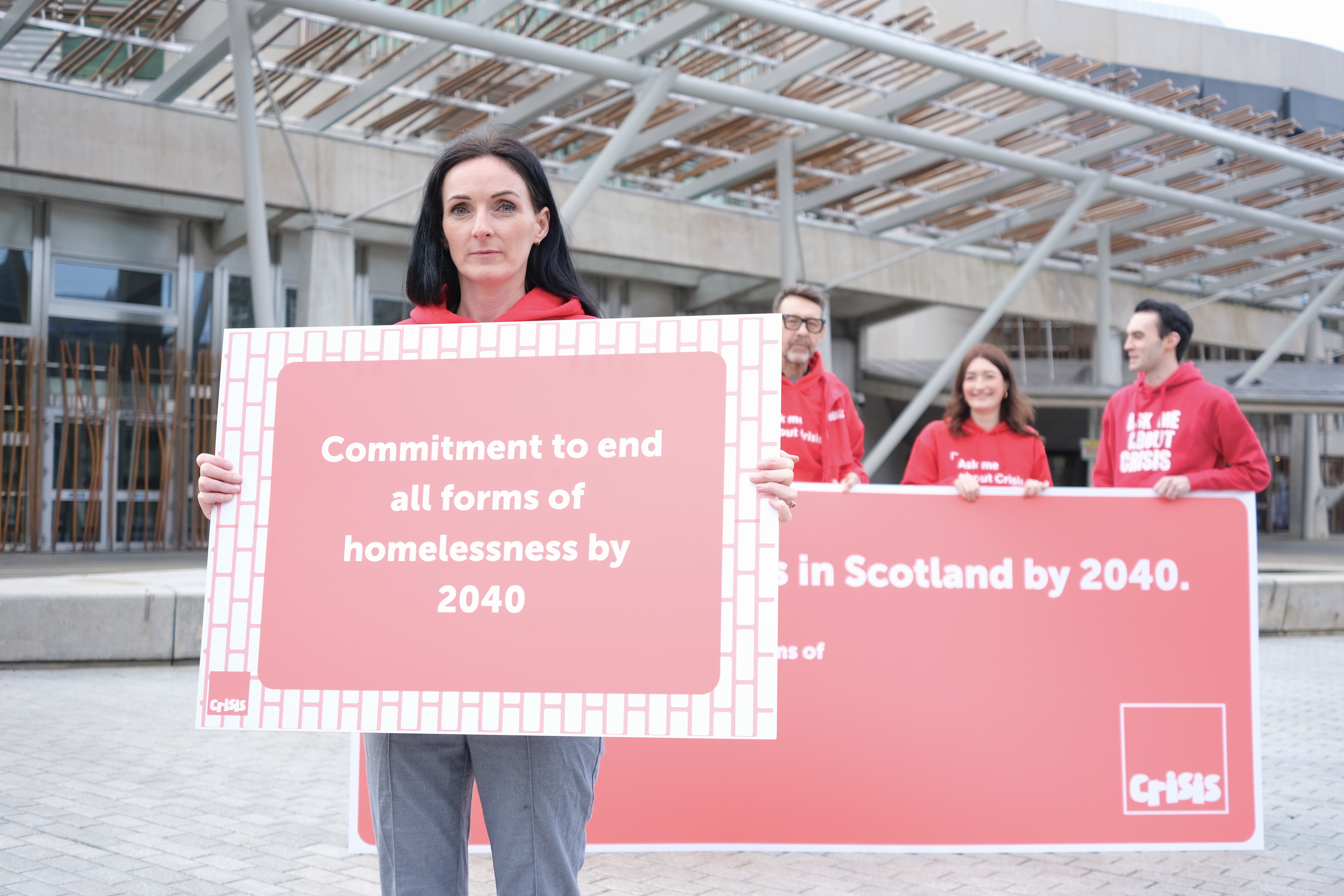
Crisis Scotland's Maeve McGoldrick during a previous campaign outside Holyrood
Crisis Scotland is urging the next Scottish Government to make ending homelessness a defining mission, adding that the rising number of people experiencing homelessness is the result of “political choices”.
With John Swinney expected to be re-elected as the first minister of Scotland, a letter from the charity has called on the new government to set out its plans to end all forms of homelessness in its first 100 days.
Crisis Scotland wants urgent clarity on how the new government will deliver on prevention, long-term investment and stronger cross-government leadership.
There were 33,966 households assessed as homeless or threatened with homelessness in the year to September 2025.
Official figures show that since 2021 rough sleeping has more than doubled in Scotland, an 111% increase. The number of households assessed as homeless has increased 18%, with an increase of 27% in the number of households in temporary accommodation.
The number of children experiencing homelessness and in temporary accommodation has increased by more that 25%.
Maeve McGoldrick, head of policy and communication, Crisis Scotland, said: “The figures are stark, and a badge of shame on our nation.
“While Scotland has made significant progress over many years in building some of the strongest homelessness rights in the world, far too many people are still being pushed into homelessness every day. Surely it is time to say enough is enough, and to make the political decisions – as hard as they may be – to end homelessness for good.
“We have evidenced how homelessness in Scotland can be ended by 2040. It’s time for the Scottish Government to grasp the opportunity to build on the progress made by making ending homelessness a clear national mission from day one.”
Maeve Mc Goldrick added: “We also need urgent action to implement Scotland’s prevention duties and significantly increase the supply of social housing, because building enough social homes is essential if we are to end homelessness in Scotland by 2040.
“With the right leadership, investment and collaboration across Parliament, Scotland can move significantly closer to ensuring everyone in Scotland has a safe and affordable home.”
According to Crisis Scotland, homelessness cannot be solved by housing policy alone, and progress will depend on coordinated action across government to address the underlying drivers of homelessness, including poverty, trauma, domestic abuse, care transitions and the experiences of people leaving prison.
Recent polling commissioned by Crisis Scotland highlights the scale of public concern around homelessness. Research carried out by Ipsos found that a quarter of people in Scotland have experienced some form of homelessness themselves or know someone close to them who has.
The survey of 1,050 adults aged 16+ across Scotland also found that seven in ten people (70%) are concerned about the scale of homelessness in Scotland, while the same proportion believe political parties should make ending homelessness a national priority.
In all, Crisis Scotland is calling for a clear commitment to ending all forms of homelessness to be included within the government’s first 100 days priorities and forthcoming Programme for Government.
The charity has backed Shelter Scotland’s call for continued cabinet secretary-level leadership for housing, recognising that ending homelessness requires sustained political leadership at the highest level of government, and wants to see a cross-portfolio approach to homelessness prevention, bringing together housing, health, justice, social security and child poverty policy.
According to Crisis, the government should invest fully in the new legal duties by putting in place an ambitious implementation plan for urgent transition to early action and preventative support, and produce an ambitious and fully funded implementation plan for new legal duties, allowing an urgent transition to early action and preventative support.
Long-term investment in social homes is also required if homelessness is to be ended by 2040, the charity added.

Share this article:

Subscribe to our newsletter to not miss articles like this one:
 SUBSCRIBE

