

Historic status ruled out for Edinburgh block earmarked for demolition
 Reading time: 7 minutes
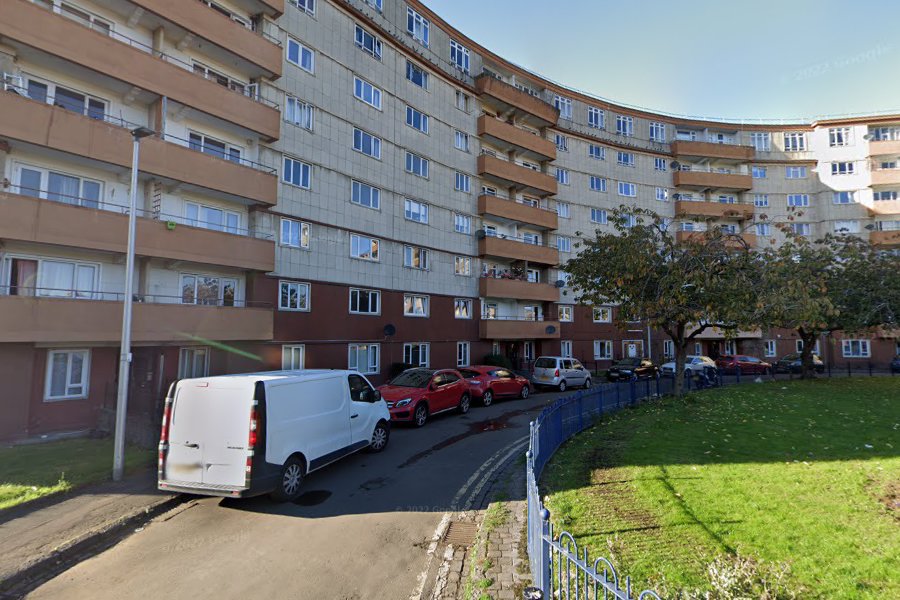
Westfield Court (Google Street View)
Plans to give listed status to a troubled Edinburgh block of flats have been dropped, clearing the way for the City of Edinburgh Council to press ahead with a buy-back programme for owners at the building.
The decision brings relief to many owners at Westfield Court in Gorgie who had campaigned against listing, fearing they would be left with repair bills they could never afford. It is also welcome news for the council, which wants to demolish the building and has plans to replace it with new social housing.
But it will disappoint others in the block, including some who worry that demolition will mean being forced to sell their flat at a reduced price, leaving them unable to afford to buy elsewhere.
Westfield Court is an eight-storey block of 94 flats built in 1952, one of Edinburgh’s first ventures into mass multi-storey housing. The council owns 32 of the flats and says the building is “beyond its serviceable life.”
For at least a decade, the block has been hit by leaking waste pipes, with sewage penetrating some homes and, in places, causing ceilings to collapse.
The pipes run through narrow shafts inside people’s flats that have no safe access or working platform and contain asbestos, making repairs difficult and costly. A condition survey carried out in June 2025 found the problems with the risers and waste pipes had worsened and concluded that repairs were no longer economical.
Since then, further issues have emerged. Emergency work has had to be carried out on the heating system and on loose masonry cladding panels to keep residents safe while a long-term way forward is agreed.
Councillors on the housing, homelessness and fair work committee were asked in December 2025 to approve demolition, but the meeting was disrupted by protesters, and residents and the tenants’ union Living Rent argued that the building’s condition was the result of years of council neglect rather than a reason to knock it down. A decision was put on hold pending further investigation.
Rather than proceeding straight to demolition, the council began negotiating to buy back homes from owners, aiming to secure the whole block before any decision on knocking it down. It made 45 offers, 28 owners obtained valuations and 13 had accepted by the time the process stalled.
That stall came after an application was lodged with Historic Environment Scotland (HES) to have Westfield Court listed. In May 2026, HES told the council it considered the building met the threshold of special architectural and historic interest, on the basis that it was Edinburgh’s first post-war venture into mass multi-storey flats, and among the earliest in Scotland.
HES said listing was “likely,” subject to a public consultation, and the council paused both the buy-back scheme and a report that had been due to go to committee while it awaited a final ruling.
HES has now confirmed it will not proceed with a consultation and will not list the building, citing its policy of not intervening where development proposals are already at an advanced stage.
The organisation said: “Our assessment using the selection guidance shows that Westfield Court meets the criteria of special architectural or historic interest for listing. However, in line with our policy, we are not proceeding at this time with a proposal to list because there are development proposals at an advanced stage. Should the development proposals affecting the site not progress we would be in a position to consider our decision again.”
The council was notified of the decision on 30 July 2026. It says it will now bring a report to the Finance and Resources Committee on 24 September recommending it resume purchasing properties from owners who wish to sell, where terms can be agreed.
Reaction
Lisa Cockburn, of the Westfield Court Owners Group, said the decision had lifted “an enormous weight” from many owners’ shoulders after months of uncertainty over the future of their homes, while acknowledging that others in the block would be disappointed.
“While this decision will come as a relief to many, we recognise that some people will be disappointed by the outcome,” she said. “This has never been about dismissing those views. Our concern has always been the reality facing the people who own and live in the building today.”
Cockburn said the voluntary buy-back programme represented “the only realistic route out of an increasingly unmanageable situation” for many owners, and urged the council to move quickly to complete it. “Today brings relief, but for owners it is not the end of the journey,” she added.
Gordon Maloney, chair of tenants’ union Living Rent, said the council’s handling of Westfield Court had been “consistently shocking.” He argued that even had the building been listed, residents would still be living somewhere in a state of disrepair unless the council carried out proper maintenance.
“For years they have neglected to do proper repairs on the building and have completely failed as a landlord and factor,” he said, calling on the council to complete repairs and ensure no resident is made homeless as a result.
Housing convener Cllr Tim Pogson said: “I appreciate that this has been a very difficult time for everybody with an interest in Westfield Court and I am pleased we have more clarity over the future of the building. We’ll now be able to resume discussions with owners who are interested in selling their properties to us. We’ll be writing to owners with information on the next steps for the future of this complex building and will continue to provide support to those affected.”
The council’s position
The council has pointed to costs as central to its opposition to listing. In its own account of the process, it says officers believed that if listed status had been granted, the cost of essential repairs — already considered unaffordable by many owners — was likely to rise further, and that this could have limited its ability to invest in the building at all.
Under the terms of owners’ title deeds, all owners, including the council, are responsible for their share of repair costs. The council says the scale of the works needed is significant, and that even with grants or payment plans explored, costs are likely to remain unaffordable for most owners however they are spread over time.
The council factors the block on behalf of owners and says all recommendations have been made in its capacity as a landlord and property owner, informed by its own officers and independent consultants, rather than through any special regulatory authority. It says it has used emergency powers under the Tenements (Scotland) Act 2004 to carry out temporary safety works, including securing loose masonry and repairing pipes affecting the heating system, and that any long-term repair plan requires the backing of a majority of owners.
It also says it has stepped up engagement with residents, with specialist staff based in the building since October 2025 and, since March 2026, running a drop-in service three days a week from its local office in Wester Hailes, alongside a lengthy series of newsletters, letters and information sessions dating back to 2025.
The council says it continues to engage with Living Rent but that it has also heard from owners and residents who say the union does not represent their views, as well as from others who support the direction it is taking.
No final decision on demolition has yet been taken, and the council says it will consider alternative repair proposals put forward by owners, though it has not identified a formal consensus among owners on a way forward. The September committee report is expected to set out the next steps for the voluntary buy-back scheme.

Share this article:

Subscribe to our newsletter to not miss articles like this one:
 SUBSCRIBE