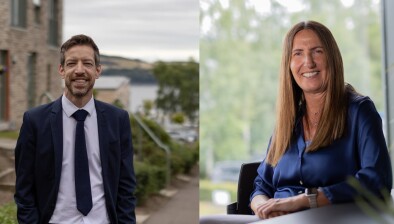


Kerry Mackie: Delivering sustainable retrofitting isn’t a product, it’s a promise to people
 Reading time: 7 minutes
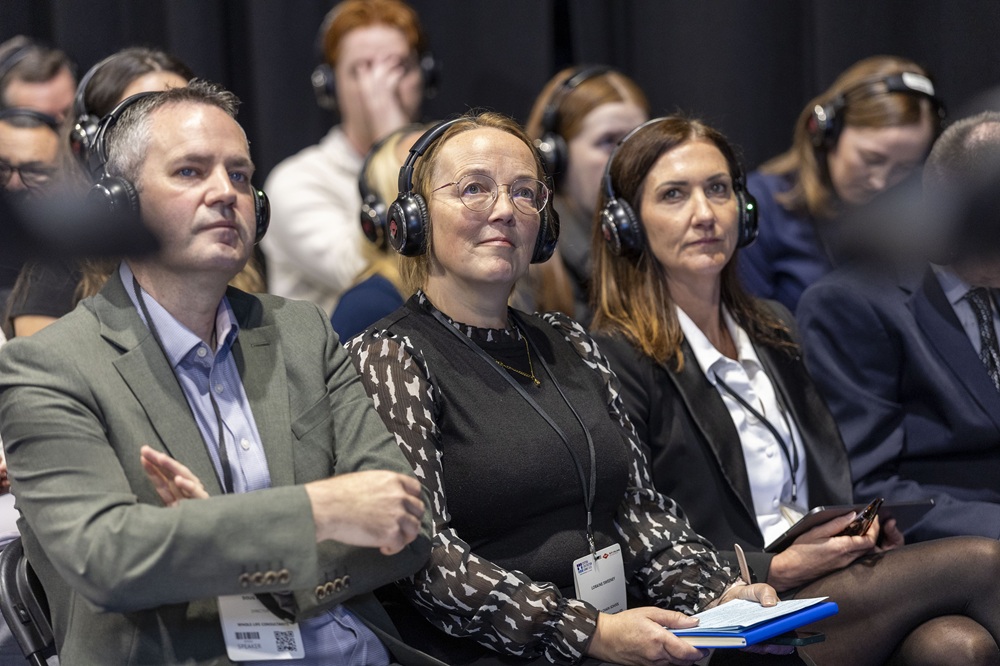
Retrofit panel members Doug Forbes, director at Whole Life Consultants, and Kerry Mackie, business growth director at Procast Group (right) with session chair Loraine Sweeney from Supply Chain Sustainability School (centre)
After appearing on the Scottish Housing Summit stage at last month’s Scottish Construction Summit, Kerry Mackie, business growth director at Procast Group, reflects on the day and the discussions around sustainable retrofitting.
Sustainable retrofit is about far more than reducing carbon emissions, it’s about people.
While decarbonisation is the bedrock of what we are trying to achieve, truly successful retrofit must deliver lasting benefits for the peoples whose homes we’re working in, the communities around them and the environment we all share.
At Procast, we believe good retrofit starts with a simple principle that homes should be affordable to live in, healthy, comfortable, durable and safe from moisture.
Improving a property’s energy performance is essential, but it must never come at the expense of the people living inside it. The real measure of success is whether our work makes homes better places to live, both now and for generations to come.
That means looking beyond legislation, funding criteria and performance benchmarks. Each has an important role to play, but our motivation must be greater than meeting minimum requirements. And this has been an integral part of our approach since our inception as a business.
We have a responsibility to future-proof Scotland’s housing stock, making improvements that stand the test of time and deliver meaningful, lasting change.
Getting retrofit right first time is critical. We are working in people’s homes, and the consequences of getting things wrong can be significant for residents, property owners and the public purse.
As a country, we cannot afford to undertake work that fails to deliver its intended outcomes, nor can we afford to pay twice to correct avoidable mistakes.
A fabric-first approach, supported by careful planning, the right expertise and a thorough understanding of each building, is fundamental to getting it right.
Equally important is a holistic, collaborative approach. Every property and community has its own needs, and successful retrofit depends on listening to residents, working closely with clients and bringing the right people together from the outset.
I’ve looked at retrofit from three seats: manufacturing the products, in the businesses that install them, and sitting on the client side as a non-executive at a housing association. From every seat, the lesson is the same. The failures happen in the gaps between us.
The designer who never meets the installer. The assessor who is never asked back. The contractor who has moved on before the first winter. The resident who was told what was happening but never asked.
Across Scotland we see the challenges. Walk up any tenement stair and you might find a council tenant, a housing association tenant, an owner-occupier and a private landlord sharing one roof. You cannot retrofit half a building. You either bring everyone with you, or it doesn’t happen.
That is why I believe the single biggest lever we have is long-term partnership. Multi-year frameworks give contractors the ability to invest in apprentices, local supply chains and proper quality systems instead of chasing the next tender. Allowing landlords, manufacturers, contractors, researchers and residents learn together, project after project.
At Meagher Court in Cumnock, our work with East Ayrshire Council and The Energy Agency is phased deliberately so that each block learns from the last and it is being independently monitored through UKRI and EPSRC funding. We want the evidence, not just the handover certificate. That kind of learning only happens when people agree to be in it together for longer than one contract.
Monitoring performance and analysing data after installation is also essential. By understanding what works, learning from experience and applying those lessons consistently, we can continually improve the quality and effectiveness of our projects.
There is also a significant opportunity to create wider economic and social value. Investment in retrofit can support local economies, create skilled employment and open doors for the next generation through apprenticeships and training. Done well, it is not just an investment in buildings, but in people, skills and stronger communities.
Scotland’s homes need Scottish solutions. Our buildings, climate and communities demand an approach grounded in local knowledge, collaboration and shared ambition. With the
2045 net zero target approaching, we must work together across the industry to accelerate progress without compromising quality, safety or residents’ wellbeing.
Indeed, sustainable retrofit is not just a technical process or a box to tick. It is a commitment to doing the right thing, learning continuously and delivering homes that are fit for the future.
Most of the homes people of Scotland will live in by 2045 are already standing. We can’t knock them all down, and we shouldn’t want to. Tenements, cottages, post-war blocks: they are the fabric of our towns and the memory of our communities. Retrofit is how they earn another generation of life.
But here is the uncomfortable truth. Too often, our industry has treated retrofit as something we install rather than something we do to people’s homes. We’ve counted measures instead of outcomes. We’ve modelled carbon on a spreadsheet and forgotten the person sitting in the cold room behind it.
When that happens, people get hurt. Last year the National Audit Office reported that 98% of homes that received external wall insulation under ECO4 and the Great British Insulation Scheme had major issues needing remediation. These were schemes meant for some of the most vulnerable households in the country. Families who said yes to help were left with mould growing on their bedroom walls.
The insulation wasn’t the problem. It works, and it has worked across Europe for decades. The delivery model failed: paying for measures rather than homes, under-skilled supply chains, unclear standards and nobody checking until the damp came through.
Every one of those failures was a choice. Which means every one of them can be chosen differently.
There’s a phrase you still hear in our industry: “working in occupied homes”, said as though the people in them were an obstacle.
They aren’t an obstacle. They are the point.
Residents live through our scaffolding, our noise and strangers in their kitchens. Their patience and flexibility are what make a programme work. And they know their homes better than any survey ever will: where the damp appears, which room nobody uses in winter, which neighbour will need a bit of extra help.
At City Road in Dundee for Home Group, we retrofitted a building of occupied flats as a whole: insulation, new windows, mechanical ventilation in every kitchen and bathroom, heat pumps, and rooftop solar shared between the flats so residents can run their heating and hot water during the day at no cost. Every resident is reporting a warmer home. But one of the comments I treasure most had nothing to do with technology:
“The guys were nice and helpful and you know what, they tidied up at the end of the day.”
That is what respect sounds like. It isn’t an extra on top of quality. It is quality.
Supporting residents means engaging them before a single survey, explaining the work in plain language, showing them how their new heating works and coming back to ask how they’re getting on.
The real test of a retrofit isn’t handover day. It’s the first winter.

Share this article:

Subscribe to our newsletter to not miss articles like this one:
 SUBSCRIBE