
Passivhaus capital cost uplift ‘can be as low as 2%’
 Reading time: 2 minutes
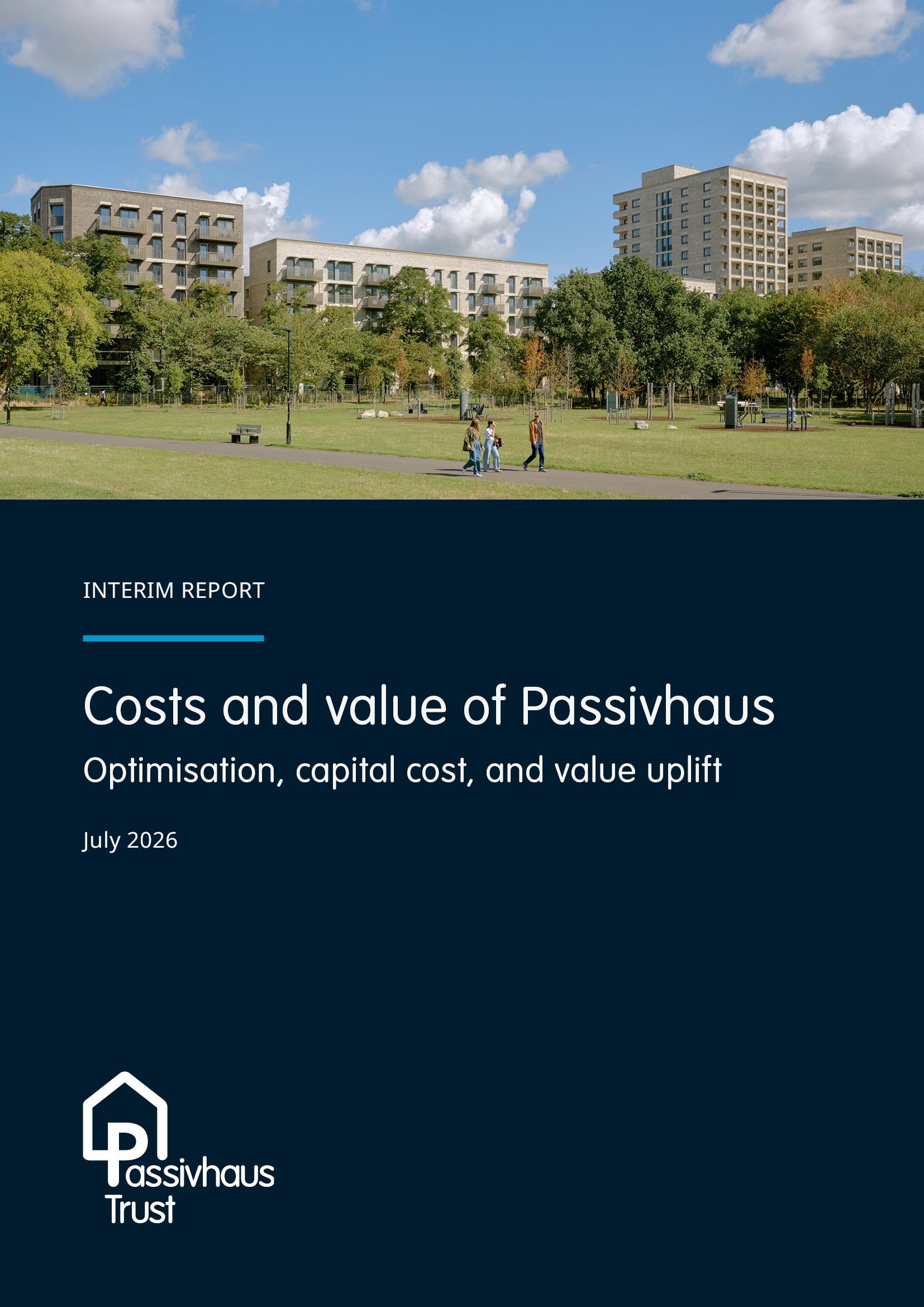
New research has been published that demonstrates that the capital cost uplift of building to the Passivhaus standard can be as little as 2% extra, and offers a range of co-benefits.
The report, co-authored by Currie & Brown, Elemental Solutions, and the Passivhaus Trust, draws on previously published modelling of the capital costs of Passivhaus construction compared with current building regulations.
The modelling suggests that the capital cost uplift from current regulations for a semi-detached house is 3–5% (£4,900–£8,500 per house), with mid-rise flats having an uplift of just 2% (£4,100–£5,300 per flat).
The smaller cost uplift for flats demonstrates how the Passivhaus standard rewards efficient building geometry. This characteristic of Passivhaus means that experienced teams can achieve more cost-effective Passivhaus design through form factor optimisation, in addition to savings from simplification of glazing design and building services. The modelling comparison assumes identical building forms. As highlighted in the paper, early design-led optimisations may bring cost parity.
The report also flags the wider benefits of delivering to the Passivhaus standard. The reduced heating demand translates into running cost savings, and certified Passivhaus buildings have been shown to reliably close the performance gap.
Other benefits may include significant improvements in health and wellbeing; increased cost certainty due to detailed early design prior to tender; lower maintenance costs; reduced voids in tenancy; and reduced defaults on rent payments. There are also potential utility connection savings for developers, due to reduced peak demand.
The costing research compares delivering to the Passivhaus Classic standard with regulations currently in force in England (Part L 2021) and Scotland (Section 6 2021).
As national standards become more demanding, the capital cost difference between Passivhaus and minimum-compliance homes is likely to reduce. Further research forthcoming in 2027 will draw on analysis of real world construction cost data, and compares Passivhaus with the Future Homes Standard and new Scottish regulations.
Jon Bootland, chief executive of the Passivhaus Trust, said: “Cost is often cited as the chief barrier to delivering Passivhaus homes and buildings. This new updated independent research shows that the uplift in capital cost is negligible.
“Passivhaus delivers lower running costs and greater confidence in real-world performance, helping close the gap between designed and delivered energy use. Wider benefits include comfort, health and indoor air quality, resilience to changing energy prices and climate risks, and improved design coordination and delivery certainty.”

Share this article:

Subscribe to our newsletter to not miss articles like this one:
 SUBSCRIBE