

Patients leaving hospital into homelessness ‘a daily occurrence’, report finds
 Reading time: 4 minutes
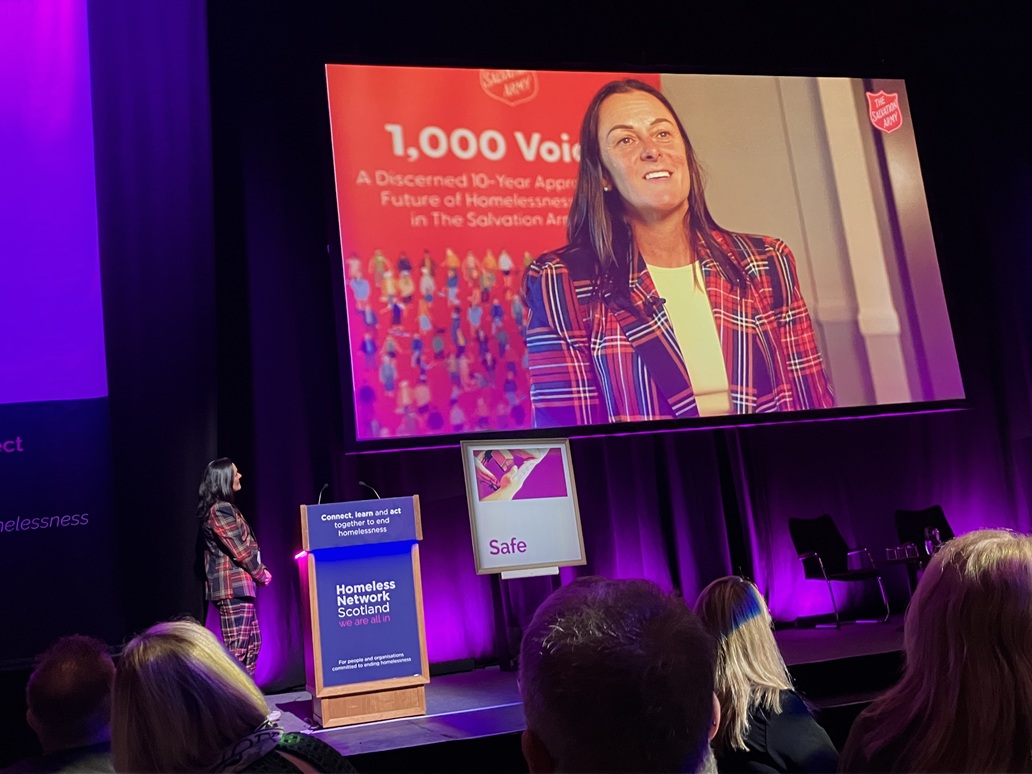
Helen Murdoch presenting at the Scottish Homelessness Conference in Perth
At least one person each day in Scotland is potentially released from hospital into street homelessness, new data obtained by The Salvation Army has revealed.
Freedom of Information (FOI) requests returned to the charity by all health boards in Scotland found that patients were discharged from hospital with no fixed abode on 543 occasions last year.
The responses received reveal a range of data from across the country, including 52% of discharges from hospitals in Scotland occurred outside standard working hours between 9am and 5pm, while 19% were at weekends, when housing support is less easy to access.
There were 2,359 accident and emergency attendances in Scotland during 2024-25 by individuals having no fixed abode. Assuming these require the lowest level of investigation and treatment, this could cost the NHS £270,000.
The church and charity is urging the Scottish Government to press ahead with fully implementing the new ‘ask and act’ obligations included in the Housing (Scotland) Bill introduced in November.
Under the legislation, all public bodies will have to ask about a person’s housing situation early and take meaningful action to prevent homelessness. However, experience from England, where a ‘duty to refer’ has existed for some time shows that putting these sorts of measures in place and getting the response right is not always easy, requiring commitment from politicians, management and staff alongside proper monitoring.
Helen Murdoch, The Salvation Army’s homelessness lead for Scotland, said: “No one should leave hospital without somewhere safe to go. Discharging someone when they have no secure accommodation doesn’t only put them at risk of sleeping rough, it puts their health and recovery in jeopardy. When people have nowhere safe to stay they are far more likely to relapse, become unwell or end up back in hospital.
“We would like to see the ‘ask and act’ requirement in the new Housing Bill fully implemented as soon as possible. We know from our own figures that more than 30% of people who come into our homelessness services in Scotland are not registered with a GP, suggesting many are using hospital A&E departments for minor injuries. We have a critical opportunity here to prevent homelessness and to save the NHS money.”
Lee (32) from Glasgow was a resident of The Salvation Army in the city. Having left residential hostel accommodation he was admitted to hospital due to complications with substance use. When discharged, he had no accommodation and nowhere safe to go and again attended The Salvation Army.
Lee said: “I knew because it was the weekend it was going to be hard to get somewhere to stay, I was really worried about having to sleeping rough and maybe overdosing again – when you have addiction issues anyway you just want to zone out when you’re facing skippering (rough sleeping) in all weathers.
“I went to The Salvation Army because I knew them, I think they contacted the council and sorted out a place even although it wasn’t the right way to do things, just turning up. You’re supposed to have all kinds of paperwork, I don’t know how they did it but they just helped. I got a place and loads of support to just level out after coming out of the hospital, that stopped me rough sleeping and maybe all kinds of other stuff happening.”
Helen Murdoch added: “It wasn’t part of our usual intake process, but the team pulled out all the stops to get the client back into the Lifehouse over the weekend. They were safe and supported, which is always our priority.
“The reality is not everyone will reach out, and we can’t promise we’ll have space every time. That’s why the new ‘ask and act’ duty matters – it makes sure there’s a clear process when someone leaves hospital, giving them the opportunity to have somewhere safe and secure to live, a space where they can be supported and have the chance to thrive.”

Share this article:

Subscribe to our newsletter to not miss articles like this one:
 SUBSCRIBE