





The Scottish Accessible Housing Network - podcast transcript
 Reading time: 39 minutes
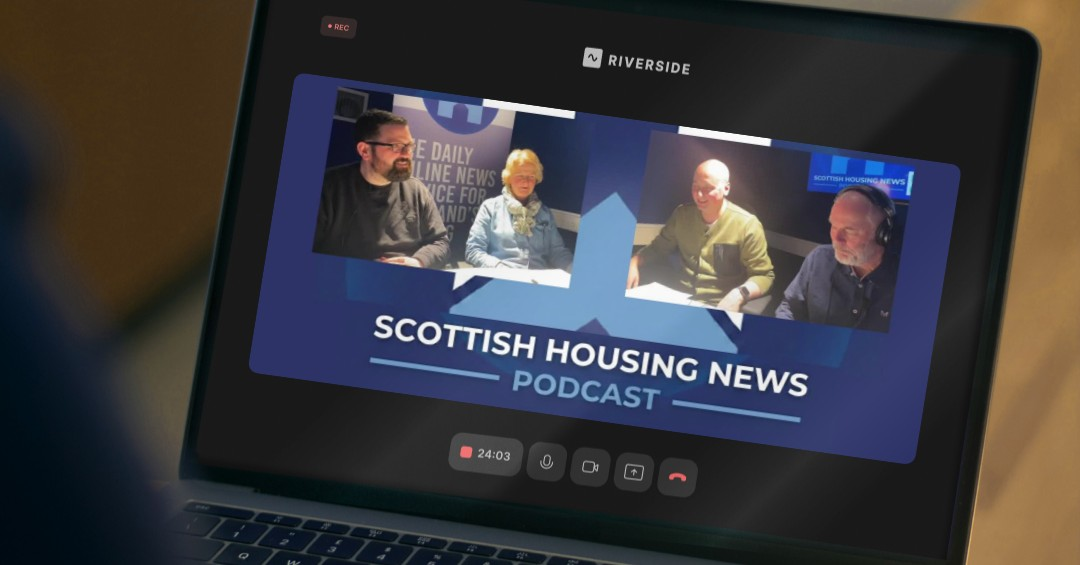
Below is a full transcript of episode 80 of the Scottish Housing News Podcast titled ‘The Scottish Accessible Housing Network with Michael Driscoll and Jill Pritchard’. Listen to or watch the episode here.
Kieran Findlay
Hello and welcome to the Scottish Housing News podcast. I’m Kieran Findlay, the editor of Scottish Housing News and today with Jimmy Black we’re doing something a bit special. It’s our first ever in person, on camera recording here in our cosy wee studio in Dundee at the DCA.
And the subject matter is a worthy one. Fresh from the launch of the Scottish Accessible Housing Network’s national call to action, we’re discussing what needs to change, why it matters now, how we build a country where everyone can live independently with dignity.
Jimmy Black
To help with this, we are delighted to be joined by Michael Driscoll, Chair of the Scottish Accessible Housing Network and CEO of Horizon Housing and Jill Pritchard, Horizon’s Chair and a leading voice for inclusive design.
Kieran Findlay
Michael, thanks for coming today. For the listeners who may not be familiar with Scottish Accessible Housing Network, how would you describe the organisation, its vision and its growing influence?
Michael Driscoll
Yes, the Scottish Accessible Housing Network has been around for a while. It’s a group of, I suppose, professionals from a variety of organisations, housing providers, local authorities, voluntary organisations, some national organisations who are all passionate in this space. So the network, as I would describe it, is it provides a space for people to collaborate, to share learning. There’s a range of projects that they’ll work on together and we work really close in some of the universities, so a number of research projects that happen over a number of years in some instances.
I suppose a space for like-minded people who are passionate in that space and to work together. People will probably know the network most from 2024 when they delivered the Housing and Social Care Accessibility Summit, which brought together a whole range of partners in 2024 to talk about this space.
Kieran Findlay
Including Scottish Housing News.
Michael Driscoll
Including Scottish Housing News. Its probably the first time I think that all these people have been brought together in one place and started that discussion. So the network is, I would say, is about creating those spaces for people to have those discussions and to do things like we’ve done with our statement where we have a collective voice and to share what’s important in that space. So yeah, it’s a really good group of people who have that passion and just want to contribute in that space and that’s what the network provides.
Jimmy Black
Okay, Jill, what’s your involvement here? What part of this are you involved in?
Jill Pritchard
So I attend the network along with a lot of other colleagues and I suppose one of the other elements of it that I think is really important is that we have a number of people from the health and social care side that come to the network too and that was part of our big kind of aim in terms of the housing and social care summit that we had.
Because a lot of the time I think we feel in housing that we’re kind of talking in an echo chamber, we’re talking to a lot of other housing colleagues and we really want to emphasise and part of what I hope we can maybe do today is really emphasise the role that housing plays in that much wider agenda of health and social care provision and particularly in terms of the early intervention and preventative agenda which is huge at the moment for all countries but is definitely a big priority for Scottish Government so we’re really hoping to kind of lean into that.
Kieran Findlay
I’ve read the statement and it’s of course housing is heavily influencing within it but you know it’s an easy read for people who are not immediately into that social housing sector.
You’ve described or the call to action statement frames accessible housing as essential infrastructure. So why is now the moment to publish this and what urgency are you hoping to convey?
Michael Driscoll
Yeah, so I think naturally it’s a good time as you run, lead up to an election and a lot of our political parties are thinking about a variety of different areas and for us it’s about trying to move this space up that list of priorities. You’ll know across the whole housing sector talks of housing emergencies, challenges around homelessness, child poverty, net zero. There’s a lot of real big challenges.
For me, I don’t feel like this particular area is up there in terms of being discussed at those levels. And you’ll see from the statement and all of the other bits that have been released by other partner, other RSLs, Blackwood have released some information as have Hanover and Bield. There’s lots of literature out there around the ageing population, dependent living accessibility. It’s a massive problem.
I don’t think it gets the airtime that it probably should. It’s not one that we’re really prepared for in any way, shape or form. You look at some of the stats there in terms of the number of people who are living in unsuitable accommodation, how are demographics in terms of age going to change over the next 20 years. There’s going be a massive shift and we’re not really prepared for that. We really need to be doing something at a national level now as opposed to being reactive that problem in 20 years.
That’s not to say there aren’t good things happening, there are, but I don’t think it gets the airtime that things like net zero and the other areas get. You don’t hear it discussed at that national level, particularly politically, and it’s a space I think that we need to try and fill and encourage more discussion on. That’s what the statement is for for me.
Jimmy Black
30 years ago, I can’t remember exactly how long ago, was decades ago, I was involved in discussions about barrier-free housing in the kind of early days of that and we were thinking that standard would maybe improve in time and we’ve got a Scottish accessible standard that people have been working on for years. Why does it never happen? Jill, I mean, what’s the problem? Why can’t we ever get our politicians to actually enact this stuff?
Jill Pritchard
Well, my personal view is that a big part of the problem is that nobody is held to account to deliver on this. So Scottish Government have a lot of strategies around this and a lot of policy documents, but there is no actual target or the regulator isn’t interested in how many accessible houses we build or how many adaptations are provided. Over the years as an OT, way back, we used to have to provide numbers on how many stair lifts we put in, how many ramps we put in, but actually that kind of information is meaningless in terms of outcomes for people.
Who almost cares how many stairlifts there are. It’s the difference it makes to that person in terms of their ability to live well and independently and to contribute to society and their whole kind of mental health and physical wellbeing. So, yeah, I think if there was a wish I had, it would be that we could have some actual targets for housing providers and for, not just for registered social landlords, but for the private sector as well, and that people could be held to account for that because we’re going to be held to account for net zero.
You know, there’s other things where there are targets, but this has never got that level of priority somehow.
Jimmy Black
Now you mentioned you were an occupational therapist. Would it be fair to say that sometimes OTs are the gatekeepers to adaptations? Is that a nice position to be in?
Jill Pritchard
It’s a horrible position to be in. But you’re right, occupational therapists are often put in the position of being gatekeepers. So occupational therapy is about absolutely putting the person at the centre, the outcomes that they want to achieve and finding solutions, whether that’s equipment, adaptations, rehabilitation, different techniques of doing things or rehousing, whatever, and tech and wrapping that around the person.
But then what tends, what has tended to happen in all my 40-odd years of being on OT is that the people that are making the decisions about policy in terms of what we provide, how much budget there is, are not occupational therapists. There are people higher up in social care and housing who are not so invested in this agenda. And so they put limits on budgets and what we can do and what we can’t do.
So my occupational therapy colleagues go out and do their best to do an assessment, make recommendations about what’s needed, but they’re not always able to provide that.
Kieran Findlay
So we’ll move on to the call to action and break down some of the priorities. One of them, as you said, was to set a national target for accessible housing. What would that look like in practice? What kind of things would be on this list?
Michael Driscoll
I suppose there’s a step before then, right, in actually understanding the demand. So you’ll see there are figures in a variety of different places around the need for accessible housing or the ageing population. But actually, do we really know what’s currently out there in our stock across Scotland?
What levels of accessible properties that we have available, you know, that are suitable and what stages of those are, to try and then, I suppose, identify what you would want to put in place to meet the need that’s there based on what you currently have.
Kieran Findlay
And what also is deemed to be accessible.
Michael Driscoll
Yeah, because you know, I’ve gone to a number of sessions, I suppose just to follow what Jill said, there’s lots of good work that goes on in this space, in pockets.
And that’s great and you could probably go to loads of different organisations and see really positive stuff. But that tends to be done in isolation amongst small groups as opposed to a coordinated strategic approach at a national level. I think that’s what the statement’s about and all the other statements you’ve seen from different RSLs are around that national picture and try to pull all that together. There’s lots of positive work but it’s not done through a national lens and that we do it strategically, collectively together. I think in terms of targets it’s about understanding what we currently have.
We know roughly the need, we know how the population is going to age over time, we have details in terms of disability and people who are on housing waiting lists, etc. You’ve got a private sector space, we’ll probably have even less knowledge, we’re a large chunk of people, either now or in the future as we all get older, are going to live. And understanding that demand and try to pull those two together. It’s no good setting, I suppose at the moment, for in development for example, people will be encouraged to have a certain percentage of properties that are accessible.
Are they truly accessible is the first thing. And you don’t want to just set a target that people just rush to achieve because actually accessibility is different for everyone. So it’s not about volume here necessarily. The volume is important, but what’s the quality linked to that? How do you make sure that is wrapped around what someone’s particular needs are? And that’s really tricky, particularly in bigger places, maybe in smaller.
So I worked in Argyll and I’ve seen really good examples of that happening in smaller spaces, where over a long period of time, they will plan for a particular family in a smaller area, knowing that that need is coming. And they can do that, you know, on a smaller scale, I think that can be done, but on a larger scale, you move into bigger places, more tricky. I think that’s why I say there’s pockets where you see really good practice, but nationally, there’s a much bigger discussion around what would those targets look like?
I don’t have an answer to it, you because a whole range of people who will have input to that and what that may look like and accessibility is one part of a much bigger picture. So nationally you need to think about how that links up and it’s been making sure it’s on that priority list though and it’s part of those discussions.
Jimmy Black
When we build new houses, is there any reason not to build an accessible house from the very start? I know you can’t tailor it for every need, but at least you can stop building barriers and blockages into it in the beginning. This may seem like a daft question, but why do we still build semi-detached houses for social housing? Is there any reason for doing that when we could build flats that are more accessible?
Michael Driscoll
I imagine our development colleagues across the sector are much more ingrained in that and it will be around cost and scale and the volume that you can build and space that’s available for you within that development. But you’re right, there’s no reason that you couldn’t a standard, a new standard that would dictate that if you put these things in place, that can be easily adapted over the space of time for someone to live there for their whole life.
As opposed to, if you look at some of the older tenement blocks that we have, there’s just no chance. You know, that wasn’t thought about when those were built and we still have, whilst it’s improved, there’s still a gap there in terms of could we do that better? But it’s not just about, we all talk about new build a lot, we’ve also got all of our existing stock. How can we do better in terms of retrofitting things there?
But it requires us to, you know, the machine just turns, we need to have a pause and think how do we stop that and then start doing some of these other thinking about accessibility and mainstreaming it into some of those other areas, is a word that Jill will use often, I’ve stolen it from Jill. Mainstreaming that into things like your asset management strategies, your investment programmes, as well as what you’re building that’s new. But of course that all comes, there’s time, there’s cost, it’s not as easy as just saying let’s do it. that’s why nationally we need to think about the whole picture.
Jill Pritchard
I think there is something about it’s not just about wheelchair housing and indeed the number of people who actually use a wheelchair indoors is it’s a very small percentage of the number of people that are living with long-term disabilities. However, the brilliant thing about building a house that’s wheelchair accessible is there is more space and lots of people with different disabilities benefit from more space as do we all actually benefit from bit more space in our homes for all sorts of other reasons.
But I think there’s two things that need to happen simultaneously. We need to be clear about, how many actual wheelchair type space standard houses do we need? But also, as exactly as you’re saying, Jimmy, is how can we raise the inclusivity standard of all mainstream houses so that as many homes as possible can be made suitable over time for people and can be adjusted? And then there’s lots of good examples of how you would do that.
Because part of that is about the fact that most people want to stay in the home they’re in. They don’t want to have to think about moving to another different special house over there. We don’t want it to be so much about special housing. It’s about everybody living in good, inclusive, accessible housing that’s easily adaptable in the main. And it’s only in certain circumstances for bespoke that people need to move.
Kieran Findlay
Talking of being inclusive, how important is it to include the views of people who would be living in the homes in the very early stages of design?
Jill Pritchard
It’s critical and I think that’s probably what lot of housing colleagues struggle with and hopefully that’s where occupational therapists can maybe bridge that gap and colleagues in social care in terms of that and yeah I mean it’s all very well designing a house that you think is wheelchair accessible or suitable for a wheelchair user and then a person goes in and finds all these things that are not working for them.
So I think it’s absolutely critical and maybe it’s something we’ve probably not been that good at doing on an ongoing basis even, you know, actually going back and saying well how is this working for you? Post-occupancy evaluations kind of approach and we’re probably always too busy doing the doing and you think well great that’s a house that’s going to be suitable for that person.
So there’s that individual type level of involving people with lived experience but also I think if we’re going to start talking, hopefully start talking about having some real targets and some real levels of inclusivity it would be crucial to involve people partly as well because you know when I started as an OT the focus was very much on people in wheelchairs but as we know you know there are so many other challenges that people face in terms of ill health and disability and so many more types of challenges around cognition and dementia and neurodiversity and more complex disabilities because people are getting much better treatment so they’re living well and better with different disabilities and with multi disabilities.
So, you know, it’s not just about a wheelchair accessible house either. So that’s where you’re absolutely right, Michael, to say we need a bit more data in a way about that. There’s lots of good information about good dementia design and a lot of dementia design is not expensive or complicated. It’s little things like having extra task lighting and different coloured door handles and grab reels. think, you know, it’s not, that’s not going to cost a lot of money. So there’s lots of different levels of intervention that would make a huge difference.
Jimmy Black
When does technology enabled care become an adaptation, for example, and putting in a dementia alarm or putting in an automatic toilet so that somebody doesn’t need someone to come into the house to help them go to the toilet? Are all of these things included in what you’re talking about as adaptations?
Jill Pritchard
Yes, absolutely. And I think part of the problem in the past as well has been that things have been divided up and kind of siloed. Here’s your equipment service and here’s your technology service and here’s your adaptation service and here’s what you pay for because you’re a landlord, here’s what you pay for because you’re social care or whatever. And I think I’m very hopeful about the adaptation review that has now kicked off in Scottish Government.
I’m very hopeful that we’ll be able to break down a lot of that because then, because what tended to happen was decisions became budget driven and different budgets were going, well, no, that’s my budget, so I’m not using that or whatever. And then gaps open up between but actually it’s back to what I said I suppose about the way occupational therapists are trained is to see a person holistically and look at everything that they’re challenged by and listen to what outcomes they want from an intervention and kind of have a wraparound package. So that would be my vision to me. So if you could make that happen that would be great.
Jimmy Black
I’ll do my level best. One of the things it gets in the way of making anything happen is the way that these things are funded. Adaptation funding is just a nightmare. If you’re a council tenant, it’s different. If you’re a housing association tenant, it’s different. If you’re an owner-occupier, it’s different. And even if you are an owner-occupier and you apply for the scheme, might not be any money there for you. So what can we do about the funding landscape for adaptations?
Jill Pritchard
Well, there is a meeting happening this very afternoon. It’s the first meeting of the adaptation review. It involves only a limited number of the stakeholders and the focus is on funding. We’ll see what comes out of that. know, SFHA are there, CIH are there, ALACHO are there, OTs are there, other stakeholders. I mean, there’s been many pieces of research and pieces of policy work, adaptive for change, et cetera, over many years that has recommended having a single funding pot.
And indeed, the people that were involved with lived experience on adapting for change way back before the report was published. That was one of the things that came up there was having one funding, a single funding pot. I don’t actually know how that would work, you know, in reality. You know, it still wouldn’t work if there’s not enough money and I don’t want to focus on there always having to be more and more money because I think, yes, we need the money to be there but we need all the processes and policies and people being held to account for the delivery to be there as well.
And then there needs to be, I think it’s back to your point about data actually, because the way that funding is decided year on year is a bit like, well, what did we have last year? What did we use and what will we need next?
Kieran Findlay
What was not spent.
Jill Pritchard
What was not spent, yeah. And in local authorities, as you probably know now, the private sector housing grant, isn’t ring-fenced. It used to be ring-fenced when it came into council, it’s not now, so it’s up to local authorities to decide what to spend, how much to put into that budget line and they have so many other priorities and challenges.
Michael Driscoll
There’s probably two points in funding. One, it’s not necessarily about having more money. It might be using the money we have smarter, in a smarter way.
So you can imagine how increasing spend and adaptations proactively versus reactively might help us reduce discharge times in hospital for people who wouldn’t have to be there because that discharge is not always about, sometimes it might be that the care isn’t there that’s available but it might also be that the adaptation of what’s required on that property isn’t there either and that could be resolved so you can see, and that was a big part of the discussion at the Summit, know, how about that’s two very big wheels to sort of have to pause and then think about how can we do this differently.
And I think also with adaptations funding, you know, so this year, you know, there was a bit of a delay in receiving adaptations funding. I don’t know how long, but it well into the year before we were awarded it. And we’ve got significantly more, which is brilliant. But that’s a big ask to deliver that amount in that space of time. And again, it’s very reactive. So for us at Horizon, we will do that.
Kieran Findlay
So I take it you’re wanting a multi-year thing. Where there’s not a rush to spend.
Michael Driscoll
Yeah. So we’ve got cyclical and planned investment programmes that run over, you know, was just planning over five years. If we could have something more long term, we would be able to plan that in advance and spend it in a smarter, more planned way. And that’s not to say we don’t do it in a smart way now, of course we do. We work with our OT colleagues and we know our customers well. People will know what they need to live more comfortably over a period of time. But I think we could do it better. I think it could be more controlled.
And I just think a more long-term view of it would allow all of us to plan better. And as a result, you would get better outcomes for the people that are using a service. But again, it requires that pause and to think about it differently, which takes you back to that national picture. And so they’re all connected. It’s not an easy space for the Scottish Government, politicians, there’s so much there. There’s so much there. But you can see where there’s linkages. And we could be thinking about doing smaller pilots or different things in different areas to try some of this stuff and think about how we could do something differently.
Where you could be reducing discharge times by doing different things with a housing provider or councils and see how it works. But we need to take that pause and do it. And just on the development piece we spoke about, I just wanted to swing back to that. In terms of new development, what we deliver is fantastic. You’ve got some of our new developments, social housing providers are building, they’re fantastic. So it’s not about saying we must have targets for just accessible housing, because what’s there’s great, what we need to do is, because we need to build more. Loads of people are homeless.
Waiting lists are crazy, so the volume is really important. So it’s not about prioritising one over the other, but what we’re already building, that great product we’re already building, what can we do within that to capture that accessibility piece as well? Because it’s great, what we’re doing is great, how can we adjust that ever so slightly just to make it more future proof? But yeah, I just didn’t want to leave it on that because I think the development work we did is brilliant. It’s just those little changes I think.
Could we have that, think about how we can do that a little bit better and capture the challenge of homelessness and how do we increase the level of properties that are available whilst making them fit for purpose in the future at the same time?
Jimmy Black
Well, interestingly, if you’re wanting a council house nowadays in quite a number of towns in Scotland, in Dundee, 75% of all of our houses go to homeless people. You could almost begin to argue that the only way into a council house is to be homeless. And that’s not going to be good for people who are stuck in hospital, waiting for a discharge, who maybe don’t quite fit that homelessness priority, don’t fit the rules. That must be a matter of concern, surely.
Jill Pritchard
It’s a huge matter of concern. You know, if anybody ever manages to get some money out of health into housing. Because if we, it’s just again as Michael has said, you know, if people are stuck in hospital because there isn’t a home for them to go to, then that hospital bed is costing an awful lot more money than it might cost to actually make, find a house that’s accessible for them. So yeah, we’re in a competing environment there, you know, in terms of just as you’re saying the challenges in terms of homelessness.
And then we have, there are more and more people who are in the homelessness system who have disabilities now as well and who are older and have particular challenges around that. These things are coming together as well. So we need to treat things more holistically.
Michael Driscoll
I think that social housing is one part of the market. The private sector is another massive part.
Kieran Findlay
This is what I was going to say. I listening to the organisations that Jill was rattling off about who’s there and please I’m not saying that you’re saying they’re not there but…
I didn’t hear the Scottish Association of Landlords.
Jill Pritchard
They are there actually, sorry.
Kieran Findlay
Great to hear.
Jill Pritchard
John is there.
Kieran Findlay
John Blackwood yeah. And volume house builders, are they represented?
Jill Pritchard
Well I know. I don’t know. I don’t know. And that would be what I would be saying if I was at that meeting. Unfortunately I’m not.
Kieran Findlay
Absolutely, yeah. Because I think it’s very much one thing a social landlord being in charge of a build, bringing a contractor and telling them what to do. Yes. There’s talk here about tenure neutral and adaptations or a standard. That would be great to see them now.
Jill Pritchard
That would be great to see that.
Michael Driscoll
What you see in some, so there is progress in the private sector and if you go on some of the search engines now, you’ll see some where you can filter by accessibility. You’ll be able to do it. Not at all, but some you’ll see that space, so there’s progress there. One of the discussions I had with someone recently at an event was if you wanted to purchase a home, but you needed a home that was accessible or had certain things as in the private developer field.
I’m not even sure how you would find that, where you would search for that. It’s not a criticism, they’re in a different space, but there’s a gap there, and how could you bring them into that? It’s totally different, they’re working from a commercial mindset, you get the space they’re in, totally different animal. But how do you incentivise or bring them into that space to try and create that? Because there are people there who need adapted properties or accessible properties who are in a space to buy.
Kieran Findlay
Yeah, absolutely.
Michael Driscoll
You know, they don’t need a social property.
Kieran Findlay
They don’t fall into the social rent allocation policy.
Michael Driscoll
How do you capture the one? So I think it’s wrong to assume that, you know, the default for everyone is, you know, an accessible property is in social housing because the reality is, is that’s just not possible.
Jimmy Black
But there is something else. There is another option. It’s mid-market rent. Is anyone doing that for accessible housing? Why wouldn’t they?
Jill Pritchard
No, I know, that’s a very good question and I don’t know the answer to that. That would be interesting to find out. But yeah, mean, it’s always been a challenge and particularly for often older people and families would be the ones that I would say as being people who have the most challenge in the owner occupied sector. You know, an older person who’s living in a big house, they want to right size and they want to find something near maybe where they live and they want it to be more accessible.
Trying to find that, I mean, I know because I’ve been involved with friends, trying to find that kind of accommodation for their parents or whoever and that is hugely hugely challenging and often, you know, an estate agent will say it’s accessible but you get there and it’s like on a hill with three steps at the front door that could never be ramped, you know. So it comes back to something you said earlier, I think, Kieran, is about we don’t have an agreed standard of what accessibility means.
Kieran Findlay
We don’t have one for affordability so.
Jill Pritchard
No, I know.
Kieran Findlay
We call ourselves an affordable housing sector.
Jill Pritchard
That’s right, that’s right. And we’ve tried to pin that down and we have lots of ideas of how that would work but wouldn’t that be great if that could be something we could tackle nationally and have an agreed standard? I mean that would be a huge step forward.
Michael Driscoll
I think a baseline would be really good.
Jill Pritchard
Minimum accessibility.
Michael Driscoll
To feed into design standards that landlords would have. It’s okay for Jill and I to say that, but our colleagues who have been working in development and understand the costs and the challenges of that space will also have a contribution there in terms of is that deliverable, which brings you back to that national piece in terms of how do we fit it all together.
Kieran Findlay
Michael, you and I have sat on award judging panels.
Michael Driscoll
We did.
Kieran Findlay
And Jill, you may have done the same, but where accessibility for its own sake is often seen as, well, it’s not a category worth entering or it’s not a popular category, shall we say.
Despite many great developments, I would say being worthy of celebration, and again for the sake of accessibility on its own. So how do we shift the narrative so accessible housing is seen as mainstream and not niche?
Michael Driscoll
You me to take that?
Jill Pritchard
Yes, you start.
Michael Driscoll
OK. So I think for us, we sponsor the Excellence in Accessibility Award with the CIH, which we introduced last year. And we do the same with the Scottish Home Awards, which is predominantly our developer partners.
Kieran Findlay
Yeah, so is that part of the thinking as well?
Michael Driscoll
Yeah, so it covers two spaces and I suppose for us that’s about, it doesn’t take a massive amount from us to do it. You know, we provide a space for people to share the good practice so there are people out there who are going that extra mile and doing really good stuff in that accessibility space and it gives them the opportunity to celebrate that and be rewarded for it whilst others can hear about it. You know, and if that, you if it means that someone at that awards or who’s judging or who’s attending sees something and it clicks in their head six months later when they’re looking at a plan or a development and they do something differently brilliant.
You know I think it’s sometimes you want the 20% win, these little 1% that build up over time, think that is one of those. You know where you’ve got a large group of people, so we spoke about private developers and how are they involved in that space, well there’s an award there, you and I know it’s a small thing, it’s a 1% and they might be discussing it or they have something and they think oh there’s an opportunity for us to to receive recognition for that, which is really important in that space, then great.
So it’s all these little 1% and how those build up as opposed to maybe tackling that much bigger challenge in a oner. So those are, I think, really important for us. And again, it’s about creating that discussion in the hope that, as the Summit did, in the hope that people will go away and either immediately or sometime in the future, however long that might be, that something will twig that they’ve heard or they’ve read or they’ve seen and it will result in a change in approach for a particular project or something they’re doing in the future. And I suppose that’s what the statement’s about in part and the Summit was about and the awards are about creating those spaces.
Jimmy Black
Now we’ve talked a bit about lived experience being important and the design of housing. I think it might also be important in achieving change. Do we have a lobby which is made up of people who need the adaptations, people with the disabilities? Are they speaking up for themselves? Do they have a way of getting their voice heard?
Jill Pritchard
Well, I’m certainly aware that the cross party groups in the parliament, because I’ve been to the one on disability that Jeremy Balfour chairs, they have a lot of representation from different disability groups. What kind of impact that makes, I’m not sure, to be very honest. I do happen to know that the Purple Poncho Drama Group, which you may have heard of,
Have you not? Have you not? You need to interview the Purple Ponchos. They were at the Parliament recently. Chris was there. Yes, I emailed Chris because I’d heard about it on Radio Scotland.
Kieran Findlay
So, was this Chris Baird? Yes, I remember him from the Social Care Summit.
Jill Pritchard
Yes, because he spoke at the Summit. Chris is brilliant. And so are his colleagues that are involved. So I think that’s maybe…
The other person I heard speaking on Radio Scotland was from Inclusion Scotland, I think. So they have quite a voice, I think, but the Purple Ponchos were at the Parliament doing a drama around various challenges around living with disability in Scotland today. So I had emailed Chris to say, I hope housing and adaptations were mentioned. He said, yes, I’m sure they were. So they’re a good group, and that’s a really good way of kind of disarming politicians and civil servants and others with a bit of drama.
So yeah, I think there are voices, they’re not as, their voices are not as loud as you might have thought, actually considering the number of people that are in that situation across Scotland where they’re living in houses that are not suitable for them or fighting for an adaptation that takes them, you know, a year to get one to waiting list then two years to get the adaptation. You think there would be more and it’s really strange that there isn’t.
But I do think things are starting to happen at the moment just from a number of different kind of aspects. Things are, I was saying to Michael in the car on the way up. The planets maybe are actually starting to align around some of this at the moment. And we’ve got the ISPA project, of course, which you’re probably aware of that Vikki McCall is leading on the intersectional stigma of place, age and disability. And they’ve got a huge, so that’s a five year research programme with all sorts of really great projects going on, including their peer researchers and, you know, lots of people across Scotland and other parts of the UK actually, disabled people, people with lived experience keeping diaries about some of the challenges around different themes. So I’m hoping that some of that will impact as well.
Michael Driscoll
There loads of pockets going on in that space. We probably all agree that generally, whether it’s tenant involvement or service user involvement in different space, could probably do better at it across the piece. Again, taking that pause and getting people involved, there are good examples in pockets.
Don’t ask me to recite the various groups, but that you’ll see as you go around different spaces where that’s happening, either in organisations or within national groups, but definitely one we could probably do better.
Kieran Findlay
So we’re rounding up the episode now. Jill, quite easy question for you. What’s the one change, policy, cultural or practical, that would have the biggest impact?
Jill Pritchard
We can only have one?
Michael Driscoll
You can have mine, Jill. I’ve never really given that.
Jill Pritchard
Well, one of the things that I would love to, this is more on the adaptation side, obviously impacts across because as Michael says, the whole retrofit, most of us will continue to live in houses that already built today, not new developments. So if I could have one thing on the adaptation side of this adaptation review, it would be a national minimum framework of provision of adaptations and all that that entails as you said earlier, Jimmy, for Scotland so that we get away from the, I hate the postcode lottery thing, but you know, get away from the fact that people get a different service depending on where they live.
So I would like a national minimal framework and I would like everybody who delivers on that framework to be held to account for delivering. And the other thing I would like, and I don’t know how we do this, but I think part of why this has not got the focus that it should have had over lots and lots of years is because people think this is about other people.
They don’t think it’s about them or their father or their sister or their child or whatever. They think it’s about somebody else and it’s often only when it comes close to home that people actually pick up on this agenda. So that’s why I really like the idea of a much more sort of mainstreaming approach to inclusivity that picks up on everybody and stops it being about other people. And also I would like somebody like George Clooney to head up a campaign.
Kieran Findlay
That would be very much impractical.
Michael Driscoll
They might listen Jill, they might listen. You never know.
Jill Pritchard
They might, they might.
Kieran Findlay
Anything to add yeah?
Michael Driscoll
So I think for me, so I joined Horizon I’ve been here, you know, started January last year, and then moving into this policy space in more detail, I think for me it feels, I’ve said there’s lots of good stuff going on in pockets, but it feels quite fragmented.
I think some sort of, I know we might have had variations of this in the past, some sort of national strategy around ageing, accessibility. It’s not just ageing because there are young people who require support in these spaces, but some sort of national strategy that means this doesn’t feel as fragmented that we can attack at. We can attack and start delivering because some people will watch the podcast here and Jill and I are talking about quite specific areas and we’ll miss loads.
There’ll be loads of spaces where people think, you’ve not mentioned that, you’ve not mentioned this. And that’s totally true. These are the spaces that we’ve probably been involved in most recently, or are allying to the statement as well. But I think that’s my consistent feeling is there’s a bit of fragmentation on how do we pull that together. And I think that has to come at a national level because a housing emergency has lots of sub-emergencies within it. And how do we respond to that collectively?
Don’t ask me what that looks like or how you would do that because it’s massive task. But it feels like now is the time to think about trying to do that. So that aligns to funding, delivery, partnerships. Is there a smarter way to do this stuff? And align delivery so that we’re getting better outcomes in the long term. We’re quite reactive in lot of spaces, I think.
Jimmy Black
Maybe the new agency, More Home Scotland, or whatever it’s called, might be the answer to your prayers.
Michael Driscoll
That could be it.
Jimmy Black
I know.
Kieran Findlay
What’s next then for the Accessible Housing Network following this report launch? How can, I mean if there’s listeners here, professional, members of the public, how can they support, get involved?
Michael Driscoll
Yeah, so people are more than welcome to join the network and just get in touch with me directly. We’re always looking for new people to get involved. I think for the network, you know, a large part of the work we did this year was about obviously creating that collaborative space and a range of discussions and projects, the ISPA work.
It’s been done by Vikki McCall, features quite prominently in there. And we usually develop a sort of delivery plan over the year around what we’re going to do in the year moving forward. So we’ll develop that over the next few months, I think about what we want to be doing over that over the next financial year and what’s important.
But I think for now it’s about, I suppose, collectively sharing and supporting the statement we’ve got. It’s not just ours. There’s a lot of other RSLs, CIH, SFHA have put out their own pre-election documents and there’s loads in those but you’ll see there are aspects in relation to accessibility and ageing as well and so the discussion that probably wouldn’t be there three or four or five years ago you know it’s in there and then some of the key priorities so the space is opening up so I think it’s just doing stuff like this and continuing the discussion so that it’s taken as part of wider picture you all those other priorities but this needs to be in mix so it’s included in there as well.
Kieran Findlay
Right, thanks everyone. Thanks to Jill Pritchard and Michael Driscoll, also Jimmy Black. If you are only listening to this podcast, Michael’s mentioned we are on YouTube, so please give it a watch and give it a share.

Share this article:

Subscribe to our newsletter to not miss articles like this one:
 SUBSCRIBE

