


What housing needs from the next Scottish Government with Jen Gracie and Susan Jackson - podcast transcript
 Reading time: 20 minutes
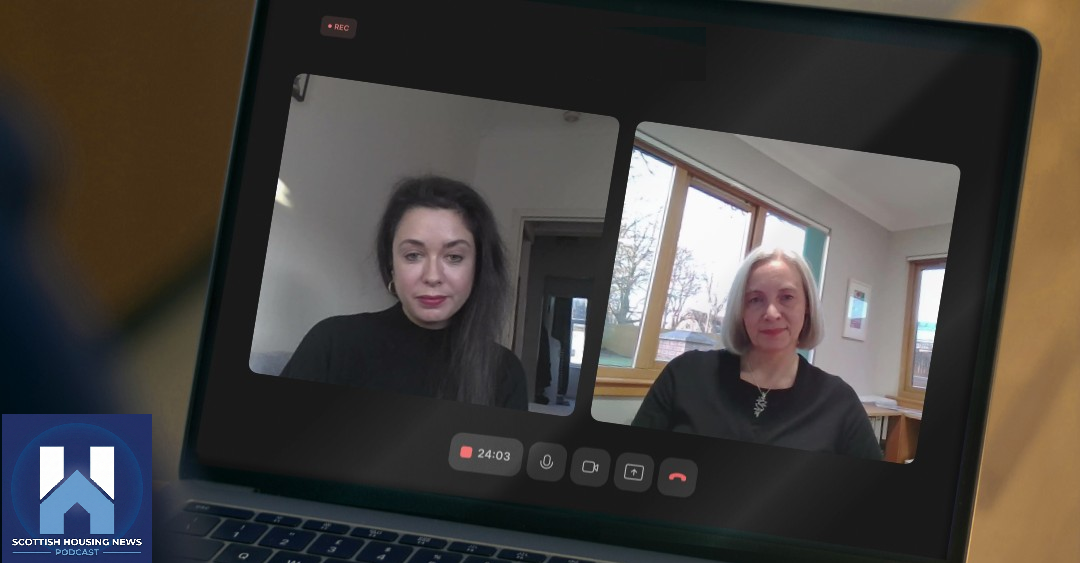
Jen Gracie and Susan Jackson
Below is a full transcript of episode 77 of the Scottish Housing News Podcast titled ‘What housing needs from the next Scottish Government with Susan Jackson and Jen Gracie’. Listen to the episode here or watch below.
Kieran Findlay
Hello and welcome to the Scottish Housing News Podcast with me Kieran Findlay and Jimmy Black. As Scotland enters an election year amid a housing emergency, constrained budgets and rising demand, our first podcast of 2026 will provide reaction to the budget but also look ahead to the election with a view to finding out what the next Scottish Government should prioritise.
Jimmy Black
So joining us are Jen Gracie, SFHA Public Affairs and Media Manager, and Campion Homes Joint Managing Director, Susan Jackson.
Kieran Findlay
Jen, welcome to the podcast. Thanks for joining us. The SFHA in the run up to this election has decided to take an approach which sees them release a series of policy papers called ‘The Road to 2026’. Why did it make this decision rather than focus on a single manifesto?
Jen Gracie
Thanks, Kieran, and thanks for having me here today.
Yeah, so last year we published a kind of staggered series of policy papers throughout the year which delved into some of the key areas which housing associations are struggling with and need Scottish Government support with, specifically the next Scottish Government. We chose that approach so that each one of these really important areas could have the in-depth, look, examination, time and actually media cut through that they needed.
We will however be publishing our manifesto that pulls out all of the key asks of that document on the 21st of January and that sets out all of those key asks for the next Scottish Government. We’re calling it ‘Housing Associations, Building Scotland’s Future’ because what it really crucially also sets out is that housing associations are core to the success of the next Scottish Government. They’re core to the success of Scotland.
All of the evidence tells us that they make Scotland healthier, wealthier and fairer. It sets out what housing associations are because we know that we’re going to see a massive turnover in MSPs and some new MSPs who are not going to know what housing associations do, the model that they work with or what they need.
Kieran Findlay
So there’s a lot to read there, are you confident that the politicians will take the time to do so.
Jen Gracie
Yeah, so what the manifesto is trying to do is really to synthesise all those key messages and then it links to the policy papers so that if you are, obviously we know that each party, each politician is interested in a particular area more than others. So you can go through to the policy papers if say you’re really interested in net zero and how we gain affordable warmth for our homes, if you’re really interested in adaptations and how we make sure that our homes suit an ageing population.
The manifesto makes that really succinct and makes very core key asks of politicians. What we have been doing, obviously, throughout the process of last year and throughout the process of the policy papers is just having those discussions. And actually they’re the most important part. We’ve met now with every key party who is likely to gain some seats at the next Scottish elections and we’ve been telling them what housing associations need to see and what should be on the top of their pile of asks, the top of their priorities when they get their first desk in Holyrood.
Jimmy Black
Susan, what would you like to see in the SFHA’s manifesto? I mean, you’re a partner of housing associations. You’ve worked with Blackwood, for example. What do you think is important? What are the important points that you would like them to get across to the politicians?
Susan Jackson
Thanks, Jimmy. So, Campion Homes is a very proud partner with many housing associations. In our 37 years of existence, we’ve built nearly three and a half thousand homes across East Central Scotland and over two and a half thousand of those are in the affordable housing sector. So our relationships with our housing associations is absolutely critical to our business.
What we’re hearing from our partners is the lack of certainty and funding is causing them immense difficulties in forward planning. And that flows down to the supply chain and we as lead developer have to manage that uncertainty with our partners. We’re in this housing emergency, there’s a crying need for more homes across Scotland. The housing associations are keen to build and we’re very keen to do that with them, but it’s the lack of certainty, the lack of future comfort that we can make an investment to help the housing associations get their developments in the ground.
So, you know, I think from the point of view of their manifesto, it’s just very similar to what we’re asking for, which is certainty of funding beyond the one year cycles that we’ve been used to over the last period of time.
Jimmy Black
So Jen, can you pick out some of the main themes that the SFHA is putting forward in the manifesto and can you take account of what Susan’s just said as well in terms of this long-term funding, long-term planning?
Yeah, I mean the overall overarching theme of the manifesto is that housing associations are absolutely fundamental to lots of the major challenges that the next Scottish Parliament and Scottish Government will be dealing with. So you can’t end child poverty without enough social homes. We know that. The evidence tells us that we can’t tackle health inequalities without enough social homes and without housing associations that help meet health and social care needs every day.
Obviously they provide homes for people who would otherwise be stuck in the NHS or in hospital. And fundamentally they make the economy stronger. Our members have about 13,000 employees and as Susan said, they make their local economies stronger. That feeds into contractors, they’re wealth creators and that wealth stays within the community.
And in terms of the other sort of key themes, it is what was in those policy papers. So it is how do we achieve affordable warmth in our homes? How do we make sure that our homes are fit for an ageing population? How do we make sure that we have that absolute certainty and clarity on funding and on net zero? Susan’s point sums it up absolutely fundamentally. What’s damaging confidence and what’s slowing down development is a myriad of things.
But very fundamentally, it’s certainty. We still don’t know what the net zero standards are going to be. And then planning ahead for that and thinking about how you might need to retrofit your homes really damages confidence. And the yearly cycle that we’ve had in the Affordable Housing Supply Programme also damages confidence because obviously we’ve seen it ebb and flow recently.
It does look like now we’re moving more to that four year cycle, which is good, it provides housing associations with a bit more certainty. But obviously now we’re moving into a period where the polls are saying it will probably be an SNP minority government, but it will still be a different government. So we don’t know that it will stick to that four year cycle. We need that certainty. And as Susan said, they need that certainty and that confidence.
Kieran Findlay
Susan, if you had certainty of funding but uncertainty of standards, describe how that could affect someone like yourself?
Susan Jackson
Yeah, so the industry has gone through a significant change in recent years in terms of the regulation that is needing to be applied. There is this sort of increasing regulatory burden being put on house builders and with new building standards being proposed, additional costs, the Building Safety Levy is the key one that is being discussed at the moment, but complete uncertainty around how much that is actually going to cost per unit. It all adds up to that uncertainty in terms of forward planning for ensuring that the developments are financially viable.
It’s really challenging. We’re in discussions with our housing association partners and in both areas of our business, so also in the private housing market. It can take two to three years to bring a development forward and if we are being told that the regulations are going to change during that period but we don’t know the cost of that, it makes it impossible to negotiate tenders with our housing association partners or indeed to make bids for land in the private housing market.
So it’s exactly the same message again is that we need certainty. We need to probably slow down the implementation of a lot of the new regulations. They may seem sensible when considered in isolation by the politicians, but the challenge is the layering effect that they have on us when they’re brought through so many and the increasing drive towards sustainability and net zero. Again, that’s just from a new build perspective, that’s bringing increasing levels of uncertainty as to what that means. So, yeah, I don’t know how many times we’ve used that word Jen, between you and I, uncertainty, but that’s, I guess, is the overriding message at the moment.
We need stability. We’ve got so many developments. We’re on site on eight developments at the moment across East Central Scotland in the affordable housing market and four sites for our private housing market and we have got an incredibly positive pipeline of work that we could be bringing forward, but it is difficult to manage our own business to ensure that we can ensure that we’ve got the right people in place to do that, that we’ve made the right investment in bringing in new people and in training, all the things that are critical to ensuring that we’ve got that stable base as a business to build the homes that are much needed. So it’s really difficult to know as a business when we can make that investment, when we can take that risk. The risk’s on us.
If we invest in the staff now with the expectation that we’re going to be building homes in three or four years’ time, we really need to have some degree of certainty that that’s going to stack up and it’s going to be financially viable for everybody.
Kieran Findlay
Just on the Building Safety Levy, as I understand it, there was a lot of work to be done to make sure that existing cladding is made safe, whether that’s taken down and replaced or retrofitted.
And the way that the government is proposing that this is paid for is a levy on new-build homes. Is that how you see it? Is there any more information than that that you know about? Because it’s in early stages of its parliamentary process.
Susan Jackson
So it is going through the parliamentary process at the moment. I understand it cleared the first stage of that, but it’s still got some way to go. We’ve seen sight of the headlines, I suppose is how we describe it.
But there’s a distinct lack of detail in the bill and there’s still further things to be clarified. Whether there’s discussion about SME home builders potentially being excluded from the levy, but they haven’t, I don’t believe, stated how many homes that would, what size of SME. We are without doubt an SME house builder, but I would describe us as heading towards the medium size. What does that mean?
So again, there’s just a distinct lack of clarity, but that potentially could bring in a significant cost per unit for house building going forward that will impact across the whole market, private housing, potentially affordable housing, although again, unclear. So yeah, it’s but it is, as you say, it is going through the parliamentary process at the moment and we as an industry are keen that the brakes are put on that.
Jimmy Black
Let’s talk about the budget a little bit now.
It does appear that there’s going to be £4.8 billion for affordable housing in the next four years. It does seem that there’s been a big increase in the affordable housing supply budget for the coming year over the last year. Surely that’s good and won’t the government be just a little peaked at the fact that the housing sector is still saying it’s not enough?
Jen Gracie
So I can come in on that in terms of the budget and in terms of the affordable housing supply program line. Obviously, it’s £4.9 billion over four years. It’s £4.1 billion in public funding. We had called for the full £4.9 billion to be at the very least public subsidy.
A closer look at the spending review shows that quite a lot of the increase is back-loaded towards the end of the period. once all of the things that we’ve been talking about, construction costs, inflation, labour shortages, regulatory processes are taken into account. So it’s relatively less? Yeah, funding in the early years of the programme appears broadly flat in real terms and that risks slowing delivery at a time when really what we need is ambition.
We recently did a piece of work with our partners at Shelter Scotland and CIH Scotland, which worked with the University of Sheffield to explore what is the actual housing need in Scotland and what is the funding that we would need in order to meet that need. What we need is actually to deliver more than 15,000 homes every year of the next parliament in order to meet housing need. And that actually requires an £8.2 billion commitment over the course of the next parliament rather than a £4.9 billion commitment.
But it also requires a bit of an older overhaul of the housing system, as Susan has talked about so well.
Jimmy Black
Susan, do you think there are any other methods of investment which the Scottish Government could deploy in housing? They’re using a non-profit distributing model called mutual investment, something or other MIM for building roads and a kind of replacement for the private finance initiative. Is there anything which you and your kind of private sector knowledge and expertise think they could do differently to bring more money into the sector so that you could build more homes?
Susan Jackson
I think one of the areas that there is a real ask in the sector is to help the first time buyer market. We need to stimulate the whole market a bit more and some help towards the first time buyer market. So the First Home Fund is a previous iteration of support the Scottish Government has been able to give and prior to that Help to Buy and that would definitely support the market if there was funding to be put in that direction.
But picking up on what Jen has said, the SFHA have obviously, they have crunched their numbers and looking at how much funding is needed to build the 15,000 homes a year. That’s the top line number. But I have concerns that the whole supply chain might struggle now with 15,000 homes per year to be built. Do we have the skills? Do we have the right skills? Do we need to be re-skilling our labour force?
We have an ageing, unfortunately in the construction sector, we have an ageing population of workers. We need to be encouraging young people to come into this sector. So I think there needs to be government attention, at least if not financial support, pointed in that direction to ensure that the training is in place, that the appropriate funding is there to ensure that we’ve got the skills, that we have the labour force to build all these homes that are so desperately needed.
We as a business are very supportive of, we have an apprenticeship programme, we’ve brought 50 apprentices through our business over the length of time that we’ve had that programme in place and we know, we recognise the need to develop young people and bring them in. So we need some government support in that area as well. Yeah, those are a couple of examples, I guess, where government could be helping to ensure we get the homes built.
Kieran Findlay
All seems fairly straightforward. You know, if you give longevity of funding, that gives employers like yourself the confidence to employ apprentices and to graduate their skills. And it gives people the confidence to enter the construction sector because there will be work there for them.
Susan Jackson
Yeah. Absolutely. Most people want surety of employment. We want to be able to give that. We want to be able to, we employ 160 people directly, but we probably engage with at least twice that in terms of subcontract labour. Our subcontractors want to know that they have surety of work, that when they roll off one development that there’s going to be work for them ahead. For fear of repeating ourselves, it’s back to that certainty.
So that four year commitment that our government has made is really welcome, but we want to ensure that when we have a new government in place come May that that commitment is kept to and it will allow everybody across the whole sector to invest appropriately at whatever position they’re in to build more homes.
Kieran Findlay
Other than simply funding, which is obviously very important, what can the next government do to unlock the supply of housing? I’m thinking in terms of planning, we’ve mentioned skills. Is there anything else?
Susan Jackson
Yeah, so all the local authorities in Scotland are currently preparing their new Local Development Plans and this will determine the allocated land for house building and other development going for the next 10 years when the plans are approved. These are taking some time to come through and as a result there is a declining supply of land for housing development across Scotland and the bare economics will dictate that that therefore pushes up the price when supply falls and there’s a huge demand.
So that’s a real challenge and we need to get these development plans through as quickly as is feasible. Different local authorities are at different stages and they’re going through the processes but we’re really, it’s going to become an increasing challenge over the next two to three years as these Local Development Plans, the old ones, run out of viable land, run out of land that is able to be developed before we get the new plans in place. So that’s a wide issue across Scotland is the falling land supply.
Jimmy Black
Jen, is there anything you would like to see in the way of land being released by hospitals and the fire service or the police when they’re disposing of surplus property? I sometimes wonder, they seem to want to go for best value and the highest price when actually they could be handing over to social landlords.
Jen Gracie
Yeah, absolutely. And one of the first things that could really easily be done, particularly for our inner city housing associations, is a mapping of who owns what land, just so they know. Particularly community-based housing associations want to build homes within their community, but often they don’t quite know who owns that bit of land, so they even, you know, even getting it at a price would be wonderful.
So I would think the first thing to do would be to create something that shows people what land is available, who owns it, and then yes, absolutely, it should be lower price for building social homes because fundamentally they’re doing social good and they make their communities flourish.
Susan Jackson
Another area that is really stifling house building, I suppose, and perhaps other development, is the investment in infrastructure. We can’t build houses alone. We need all the infrastructure that goes with that, and particularly schools, but roads and the utilities, that’s not under the control of our government, but the utilities and the infrastructure that is there to support the housing. That’s a challenge. That’s a real challenge.
And the lack of investment or how that infrastructure is to be funded is really delaying decisions on planning and then subsequently development starts. That sort of wider infrastructure issue really needs to be looked at at the same pace as they’re trying to push through, as we are trying to push through in our house building.
Jen Gracie
I think what I would add to that is, you know, even when there is land available and a housing association has the capacity and the funding to build, what Susan said is completely right. It might be the housing association going right, we can build in that area, but actually there’s no bus or train service.
So all we would be doing would be sticking people out in this area, say Glasgow, without the infrastructure and we have seen developments in the past that have been built, our beautiful new social homes waiting for families and you know we know that 250,000 people are on a waiting list for a social home they are well well needed but it takes too long to connect up the, you know, water and that can’t be right. That can’t be what’s stopping people moving into a home in their community.
Kieran Findlay
Susan, we’ll be coming to the end of the episode. Now, if you can sum up everything that we’ve talked about and give one concise ask of the next Scottish Government to speed up the delivery of more homes, what would it be?
Susan Jackson
Well, I’ll go back to what we’ve been really just emphasising throughout the discussion Kieran, is that we need stability, we need long-term surety of funding for the sector, both in the affordable housing sector and in the private housing sector, ⁓ to ensure that we as developers can make the investment that we need to grow our businesses, to build the homes that are much needed.
Kieran Findlay
And Jen?
Jen Gracie
So my one ask of all MSPs, all candidates of the next Scottish Government is to stand up for housing associations. They are building Scotland’s future. The reason for being is to tackle homelessness, poverty, support people into work or education and with their health needs they strengthen our economy and they create thriving communities. So if we want everyone to have a home and a community and all of the life chances that each of us would expect for ourselves, the next Scottish Parliament can’t be the one that falls back on its commitments to social housing. It needs to strengthen it and every MSP needs to stand up for them.
Kieran Findlay
We’ll end it there. Thanks for listening or watching, possibly, to the first episode of the Scottish Housing News Podcast in 2026. We’ll be looking ahead to the election, we’ll be looking ahead to tenement ownership and also whether the housing sector is systemically racist. That’s the next couple of episodes of the Scottish Housing News Podcast. I’ve been Kieran Findlay, my thanks to Susan Jackson, Jen Gracie and Jimmy Black. We’ll be back soon.

Share this article:

Subscribe to our newsletter to not miss articles like this one:
 SUBSCRIBE