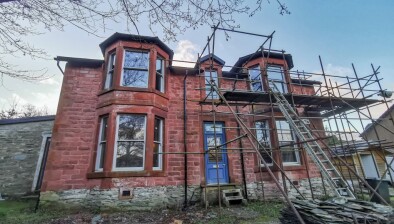


Additional £700,000 to bring empty homes back into use
 Reading time: 4 minutes

A further £700,000 is being allocated to help homeowners fund the necessary repairs and refurbishments needed to bring empty homes back into use.
The funding, which will be split across 10 local authorities, can be used to establish or extend grant schemes for empty homeowners.
It comes as a report published by the Scottish Empty Homes Partnership shows that a record number of empty homes were returned to active use during 2025-26.
The support brings the Scottish Government’s investment to transform empty homes into productive use to £2 million this year.
Announcing the fund at the Partnership’s conference in Glasgow, cabinet secretary for social justice and housing Shirley-Anne Somerville said: “We want everyone in Scotland to be able to have a warm, safe and affordable place to call home. While house building remains the cornerstone of our approach to increase supply, we’re using every lever available to make sure existing homes support the needs of our communities too. That’s why this funding matters.
“Temporary accommodation can act as an important safety net, but we also recognise the impact that long-term stays can have, particularly on children’s wellbeing and stability. This funding may help councils to move households from temporary into settled permanent accommodation.
“Our investment of £5.7m in the Partnership approach has delivered real results with more than 15,000 empty homes brought back into use since 2010, including a record 2,285 in the last year alone. This latest investment will help local authorities turn more empty homes into affordable housing for people who need them the most.”
What the report reveals
The scale of the problem
- Around 44,500 homes in Scotland have been empty for six months or more. Of these, about 32,300 are classed as long-term empty (12 months or longer).
- Aberdeen has the most empty homes (6,124, or nearly 14% of the national total). Argyll & Bute (4.95%), Aberdeen (4.87%) and the Western Isles (4.44%) have the highest proportions of their housing stock empty.
Why homes sit empty
- The most common reasons homes become empty are the death of an owner (38%) and renovation or repair work (38%).
- The most common reasons they stay empty are repairs that are still ongoing (28%) and owners who are hard to engage with (10%).
- Hoarding is highlighted as a recurring factor in cases.
- Homes that had been empty for five years or more made up a bigger share of those brought back into use than when the data was first collected in 2018/19.
Funding and services
- The Scottish Government invested £2m in the partnership this year, including £750,000 to expand council Empty Homes Officers (EHOs) and £700,000 for pilot projects. The funding continues into 2026/27.
- 28 of Scotland’s 32 councils now employ an EHO or equivalent. Midlothian created a new service and Moray restarted one, while Aberdeen, Edinburgh, Fife and North Lanarkshire expanded theirs.
- EHO advice and assistance accounted for about 89% of homes returned to use. Council buybacks doubled from 4.36% to 8.71%.
- Compulsory purchase orders (CPOs) remain little used. Only three succeeded, all in Glasgow, though ten more were in progress at the year’s end. The Scottish Government is consulting on CPO reform.
New initiatives
- A National Matchmaker service, linking owners with potential buyers, launched in December 2025. By the end of March it had 12 registered properties and 93 buyer enquiries, but no confirmed sales.
- Pilot projects include housing for keyworkers in rural areas, a Fife scheme using empty homes to tackle youth homelessness while teaching renovation skills, and a CPO “hub” hosted by Aberdeenshire Council.
- From 1 April 2026, councils must apply a default council tax premium of 100% on homes empty for over 12 months, which the SEHP says it will monitor.
Tahmina Nizam, national manager of the Scottish Empty Homes Partnership, said: “This additional Scottish Government funding to support efforts to tackle empty homes across Scotland’s local authorities will be welcomed throughout the sector.
“We know that sustained, targeted investment in empty homes can deliver real and measurable outcomes, with the Scottish Empty Homes Partnership annual survey showing a record 2,285 formerly empty properties brought back into use. Rather than lying vacant, these are now providing homes for thousands of individuals and families across Scotland.
“This has only been possible through a step-change in empty homes work. Additional investment has enabled not only the expansion and growth of empty homes services across councils, but also the sort of targeted grant support for individual projects that this new funding will help to deliver.
“We look forward to working closely with the Scottish Government, local authorities and others in the sector to ensure that this additional resource can deliver the best possible outcomes, bringing an increasing number of empty homes in Scotland back into use as affordable housing.”

Share this article:

Subscribe to our newsletter to not miss articles like this one:
 SUBSCRIBE