


Written by:

Podcast: Mary Taylor charts the rise of Scotland’s housing associations 50 years on
 Reading time: 6 minutes
Written by:
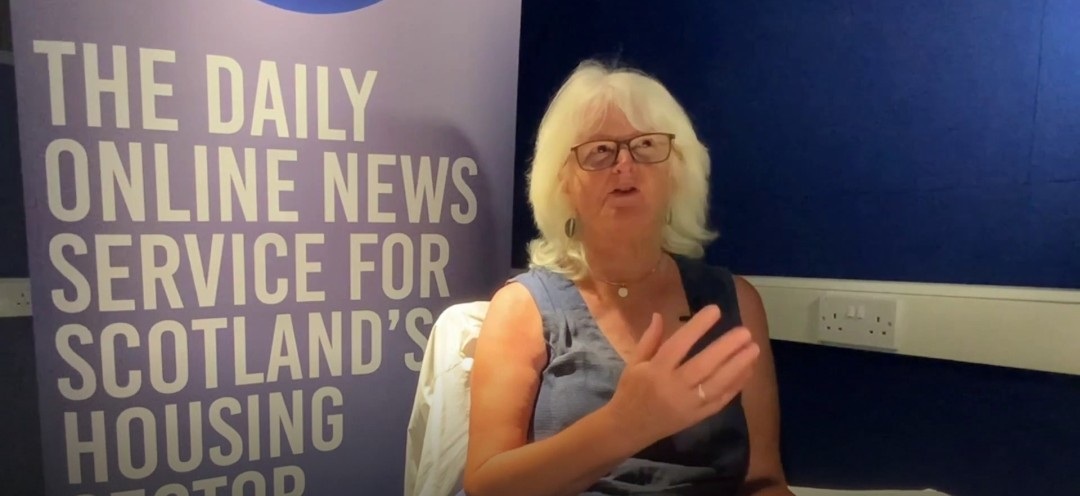
Mary Taylor
As the UK’s new Prime Minister talks up the biggest council house building programme since the postwar era, a newly published book is offering timely context on an alternative model that has quietly reshaped Scottish housing over the past half-century: the housing association.
Homes by Association: 50 Years of Housing Associations in Scotland, written by Mary Taylor with Lynn McCulloch and published by Porto Press, traces the movement from its uncertain beginnings in the early 1970s to its current position as a mainstay of Scotland’s social housing landscape.
Mary, who has spent decades in housing management, academia and as former chief executive of the Scottish Federation of Housing Associations (SFHA), discussed the book on the Scottish Housing News Podcast with Kieran Findlay and Jimmy Black.
Mary explained that the book grew out of a conversation while she was researching tenements for another project. A former colleague suggested that, given how complicated the history was becoming to untangle, someone ought to write it all down properly. She decided she might be the person to do it, and began work in earnest with Lynn McCulloch, whose long career included heading inspection at Communities Scotland and later advising associations on governance.
The timing, Mary said, was shaped by a conversation with a colleague in 2023 — a year before the fiftieth anniversary of the 1974 Housing Act, the piece of legislation she describes as pivotal to the entire story.
To understand why associations emerged at all, Mary said it helps to look at the state of Scottish housing tenure in the early 1970s. Councils then controlled roughly 60-65% of housing stock, with private renting and owner-occupation splitting the remainder, and associations barely registering. Councils had been able to build extensively using government subsidy, but political pressure to keep rents low meant maintenance budgets were consistently squeezed, leaving council housing with a deteriorating reputation even as it dominated the market.
Whitehall and Westminster had been eyeing alternatives to council-led provision since the 1930s, Mary noted, but nothing displaced councils until a chance policy request in the early 70s changed everything. Conservative minister Peter Walker asked the housing association sector, via civil servant William Waddilove, what it would take to get associations building at scale.
Despite, in Mary’s words, usually fighting “like rats in a sack” over policy, the sector united behind a four-point platform. The Conservatives lost office within months, but the incoming Labour government simply picked up the ready-made proposals and legislated them into the 1974 Act.
Central to that settlement was a 95% grant formula, calculated by taking a “fair rent,” deducting management, maintenance and reserve costs, and covering the rest through grant. Why the figure was set so generously remains unclear from the historical record, Mary said, but the effect was transformative: associations that had existed informally, often providing specialist accommodation for older people, disabled people or those with mental health needs, suddenly had access to real money, and organisations like Hanover and Bield expanded rapidly.
That generous funding model didn’t last. In 1988, under Nicholas Ridley in Margaret Thatcher’s third term, the formula was inverted: grant rates fell to around 90% (sometimes stretched to 92-93%), and crucially, associations could no longer borrow from the Housing Corporation.
Instead, they had to build relationships with banks and building societies. Institutions that knew as little about the sector as committee members knew about commercial lending. Mary said this shift exposed smaller associations in particular, with some committees frightened by the prospect of financial responsibility they hadn’t signed up for, prompting a wave of consolidation.
The following decade brought further upheaval as the Scottish Special Housing Association and Scottish Homes sold off stock, eventually standardising the process by 1992. Then, in September 2001, came what Mary calls the pivotal moment: Gordon Brown’s offer to write off councils’ historic housing debt if they transferred stock to the not-for-profit sector.
Announced quietly, in the same month as the September 11 attacks, the policy nonetheless proved decisive, with Glasgow’s tenants voting to transfer along with five other large-scale council transfers across Scotland. Freed from historic debt tied to poor-quality stock, Taylor said, these organisations were able to invest in the right housing in the right places.
Mary was particularly candid about the years following 2007, when she says the SNP government’s belief that associations could rely more heavily on private borrowing, combined with later austerity cuts, badly damaged the sector’s capacity to develop new housing. Experienced development staff left the industry, she said, and that expertise has proven difficult to rebuild.
She recalled making the case to civil servants and ministers at the time about the long-term cost of allowing that pipeline to dry up, pointing out that a child born around the time funding was cut in 2010 could be well into primary school before a promised bedroom of their own materialises.
Looking ahead to the newly proposed More Homes Scotland agency, Mary was measured. Whatever institutional form housing policy takes, she argued, the funding formula is what will determine whether the sector can deliver at scale.
Associations, she believes, have matured into organisations with strong management and maintenance capability, but face a genuine tension between borrowing to meet net zero and building-safety standards on existing stock, or borrowing to build new homes.
Asked, in a nod to a Monty Python line, what housing associations have actually done for Scotland, Mary pointed to consistently strong performance in the Scottish House Condition Survey, affordable homes matched to tenant needs, and award-winning design that treats beauty as being as important as shelter.
She also traced the sector’s now-familiar role in wraparound services, tackling fuel poverty, food access and isolation, back to the community-focused, sometimes specialist origins of the earliest associations, describing organisations like Berwickshire Housing Association as businesses with a social purpose rather than simply landlords.
On the incoming UK government’s ambitions around housing and social care, Mary argued that more supported and sheltered accommodation, offered earlier, could prevent costlier crises later in life — a message, her interviewers suggested, that applies equally to policymakers in Edinburgh as in Westminster.
Homes by Association: 50 Years of Housing Associations in Scotland by Mary Taylor with Lynn McCulloch is published by Porto Press.
The Scottish Housing News Podcast is available on YouTube, Spotify and Apple Podcasts.
Interested in sponsorship? Download our podcast media pack.

Share this article:

Subscribe to our newsletter to not miss articles like this one:
 SUBSCRIBE