

South London council housing development wins Stirling Prize
 Reading time: 5 minutes
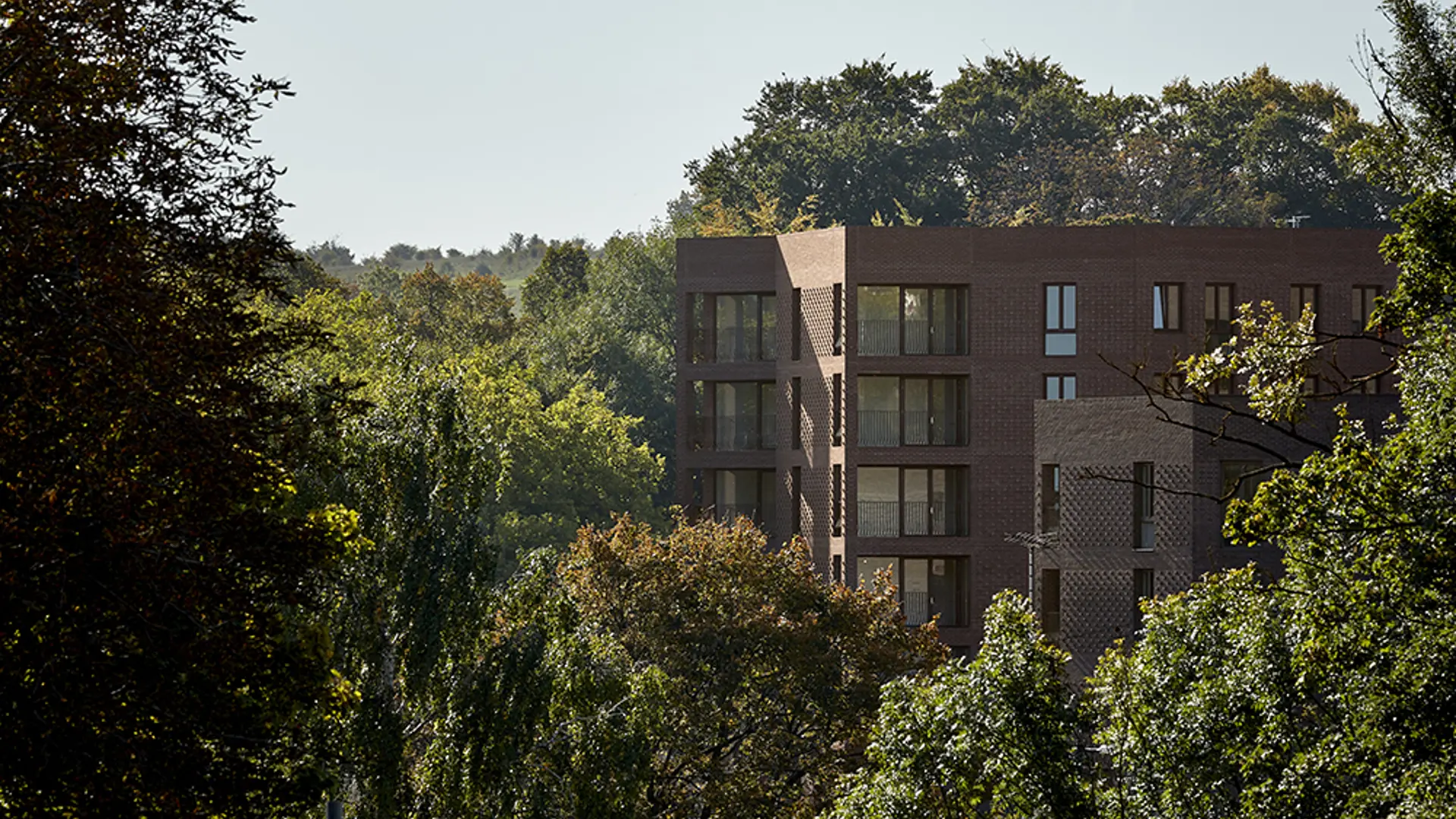
The landscape-led project has five buildings containing 157 dwellings (Image credit: Rob Parrish)
A council-commissioned housing development in Coulsdon, South London, has been awarded the UK’s most prestigious architecture award, with St Andrew’s Drive in Glasgow missing out on a housing prize.
Designed by Mary Duggan Architects with RUFFArchitects, Lion Green Road won this year’s Stirling Prize, awarded by the Royal Institute of British Architects (RIBA).
The suburban project delivers 157 dwellings, divided across five blocks, combining privately owned and socially rented homes for Croydon Council.
Replacing a former car park on a challenging, sloping site that varies in height by eight metres, the development creates a new connection between the bustling Lion Green Road and a distinctive area of green parkland beyond.
Rather than treating the site’s topography as a constraint, Lion Green Road reconsiders the conventional layout of residential streets and offers a new approach to higher density development. The arrangement uses the site’s changing levels and views to create a new “living landscape” for 635 residents.
Notwithstanding subtle variations in height, each of the five sculpted blocks is built to the same specification. However, each is carefully rotated and positioned to respond to the site’s topography and offer distinct views, with some looking towards the historic monument - the Surrey Iron Railway - a fragment of the world’s first fully independent public railway. The shared design creates a coherent family of buildings that belong within the landscape.
Unified by a palette of brickwork in three subtle shades of brown, the housing blocks blend into the parkland beyond, while small variations in pattern add texture and give each building its own identity.
Arranged around open, shared outdoor spaces, and with access to a new public pathway from Lion Green Road to parkland beyond, the blocks encourage interaction between residents and help foster a strong sense of community.
Inside, every home is dual-aspect, drawing in generous daylight, while private balconies are carefully positioned to avoid directly overlooking neighbouring homes. This thoughtful, carefully considered arrangement allows the buildings to sit closer together while giving residents open views from their own outdoor spaces. The result is density achieved through careful orientation and planning, rather than at the expense of privacy, daylight or views.
The project was designed and built to reduce its environmental impact. By using efficient construction methods, simple finishes, and a more streamlined building process, Lion Green Road was able to cut carbon emissions.
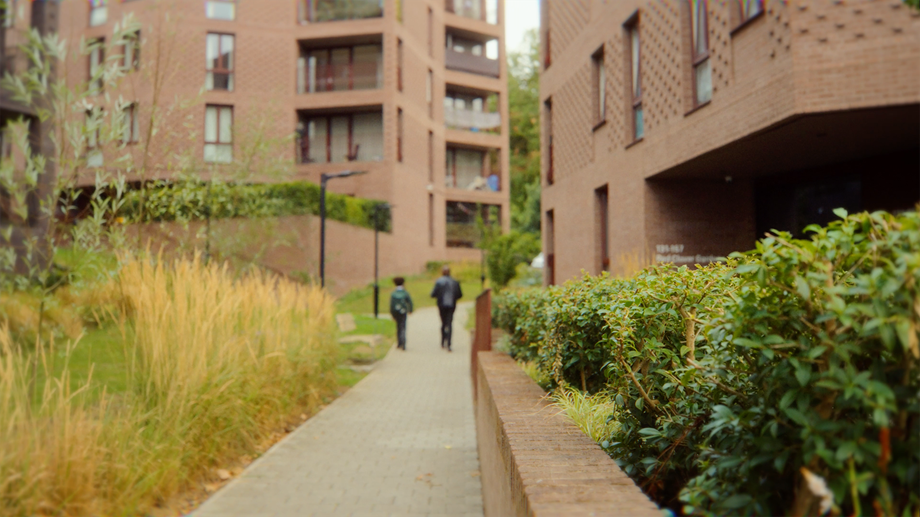
Leafy grounds and paths surround the buildings (Image credit: RIBA)
More than a housing development, the scheme has created a welcoming and inclusive place where people can connect with one another, and with nature. The children’s play areas, sensory trail and residents’ allotments have provided opportunities for recreation, learning, and community activity, bringing residents and neighbours together, while supporting the existing wildlife and biodiversity.
Speaking on behalf of the RIBA Stirling Prize jury, Chris Williamson, RIBA president, said: “At a time when we urgently need to deliver more homes, Lion Green Road shows that density can be achieved without compromising the quality of the places we create.
“Through a consistent specification, with subtle variation in height and orientation, it offers housing at scale without uniformity.
“The architects have created a new kind of garden neighbourhood that balances privacy and generous views with a strong connection to nature - it’s a living landscape.
“This is thoughtful, resourceful architecture that proves that even the most challenging of sites can be transformed into truly distinctive places for people to call home.”
Mary Duggan, director, Mary Duggan Architects, on behalf of Mary Duggan Architects, RUFFArchitects, and the London Borough of Croydon, said: “We believe the significance of Lion Green Road lies in what it says about the future of housing: that architectural ambition, social value and generosity can co-exist within the realities of contemporary development.
“The project transforms a challenging suburban site into 157 homes woven through a mature, accessible landscape, using topography, shared space and carefully calibrated thresholds to support a rich culture of dwelling. Its transformative values are not expressed through spectacle, but through the everyday experience of living in a secure, generous environment - supporting privacy and encounter, independence and belonging, and the multiple patterns of contemporary domestic life.”
The RIBA Stirling Prize 2026 is sponsored by Autodesk.
Theo Angelopoulos, VP AEC Design Strategy, Autodesk, said: “The Stirling Prize celebrates architecture at its very best, spotlighting ambitious design that responds to the needs of people and places. As the prize marks its 30th anniversary, Autodesk is proud to continue supporting RIBA in recognising the creativity and innovation shaping the built environment, and to celebrate this year’s winning project.”
Neave Brown Award for Housing
Elsewhere, a Glasgow social housing development missed out on being awarded a UK-wide housing prize for architectural excellence.
Designed by jmarchitects, St Andrew’s Drive Phases 2 and 3 in Pollokshields was named on the shortlist for the 2026 Neave Brown Award for Housing, presented annually by RIBA.
Rowan Court, an underused site transformed into 46 new social rent homes in North London, took home the prize.
The winners were announced at a ceremony on 15 October at Old Billingsgate, London.

Share this article:

Subscribe to our newsletter to not miss articles like this one:
 SUBSCRIBE